Tag: Psychiatry

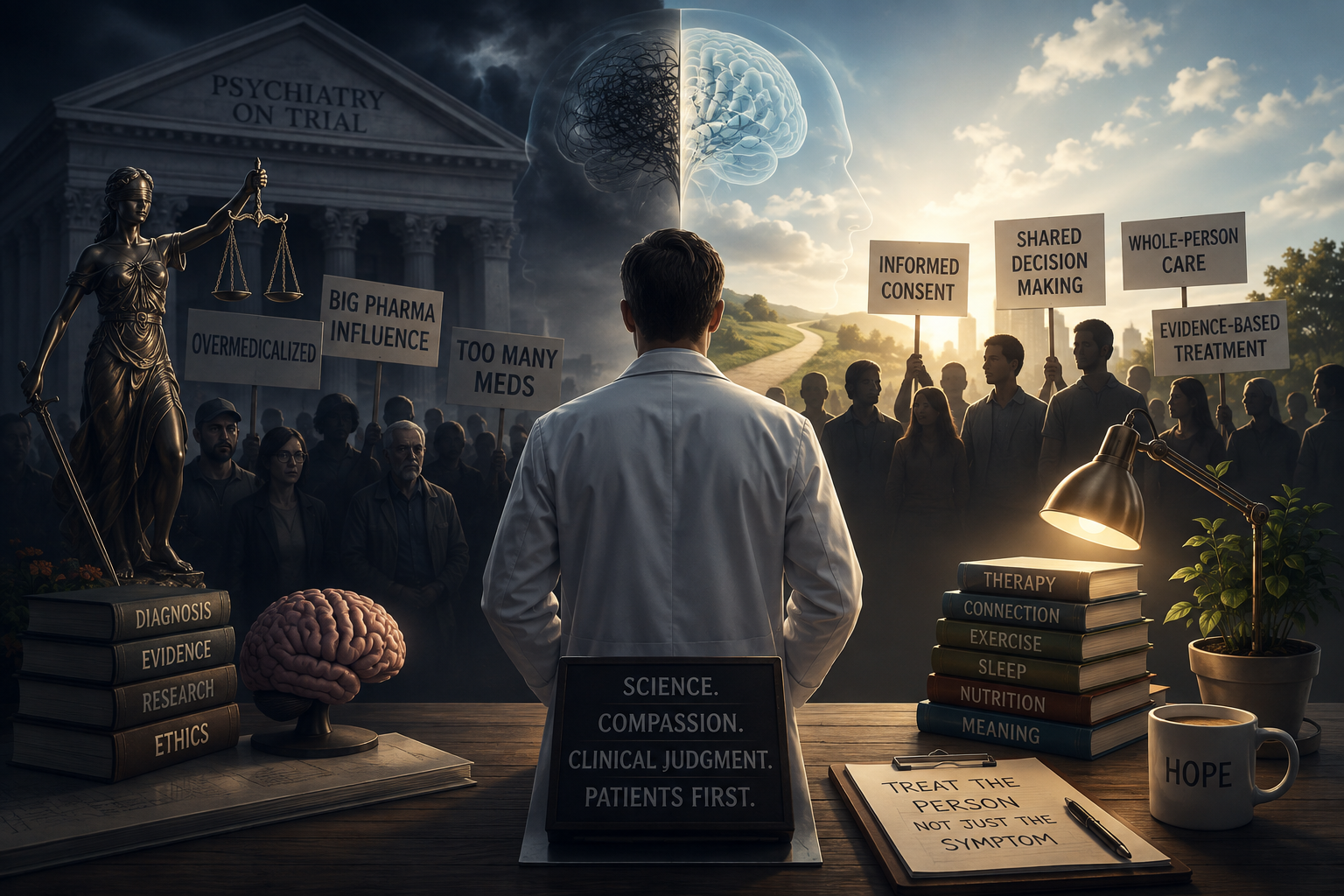
  • Psychiatry Is on Trial. We Should Not Plead Guilty to the Wrong Charges

    Psychiatry Is on Trial. We Should Not Plead Guilty to the Wrong Charges

    Psychiatry is on trial. It was probably inevitable. A field that treats suffering, suicide, psychosis, trauma, addiction, violence risk, loneliness, despair, and meaninglessness was always going to be dragged into the political arena. Psychiatry sits at the intersection of medicine, culture, family trauma, public fear, pharmaceutical influence, personal liberty, and moral injury. That makes it uniquely vulnerable to distortion.

    But the current moment feels different.

    With Health and Human Services Secretary Robert F. Kennedy Jr. placing psychiatric medications and “overmedicalization” at the center of federal attention, psychiatry is no longer only being debated in journals, clinics, and academic conferences. It is being litigated in public. Increasingly, it is also being litigated in court. On May 4, 2026, HHS announced a MAHA action plan aimed at curbing psychiatric overprescribing, promoting informed consent, shared decision-making, nonmedication interventions, and deprescribing when clinically indicated.1

    Some of that language is reasonable. In fact, many psychiatrists already agree with it.

    Psychiatric medications should not be the default response to every form of human distress. Patients deserve informed consent. Deprescribing should be part of competent care. Psychotherapy, exercise, sleep, nutrition, family support, social connection, and meaning making should not be treated as decorative add-ons. They are often central to recovery.

    But that is not the same as saying psychiatric illness is not real. It is not the same as implying psychiatric medications are broadly dangerous, unnecessary, or responsible for America’s mental health crisis. And it is certainly not the same as turning painful anecdotes into national policy.

    That is where psychiatry must draw the line.

    The American Psychiatric Association has appropriately pushed back on the idea that the mental health crisis can be reduced to overprescribing, noting that this framing ignores workforce shortages, limited access to care, lack of psychiatric beds, and uneven distribution of evidence-based treatment.2 That is exactly right. Deprescribing may be good medicine in selected cases. But deprescribing is not a national mental health strategy.

    It is a clinical tool.

    There is a dangerous pattern in the current conversation. A public figure describes a deeply personal experience: a family member struggles to discontinue an antidepressant, someone feels emotionally blunted on medication, a young adult regrets being started on an SSRI as a teenager, or a patient develops withdrawal symptoms after stopping too quickly. The story is real. The suffering is real. The problem deserves attention.

    But then the anecdote becomes a theory of psychiatry.

    The assumption becomes: because this happened to someone I love, this must be what psychiatry is doing to the country.

    That is not science. That is narrative capture.

    Psychiatry should not dismiss these stories. We should listen to them. We should admit that antidepressant discontinuation can be difficult for some patients. We should acknowledge that medications are sometimes started without a clear enough plan, continued without adequate review, and stopped too abruptly. We should be honest that some patients are placed on medication when what they needed first was psychotherapy, time, structure, sleep, exercise, substance use treatment, grief work, family intervention, or a change in environment.

    But honesty cuts both ways.

    Some patients are not “overmedicalized.” They are undertreated. Some are not being harmed by psychiatry. They are being harmed by the absence of psychiatry. Some patients do not need fewer medications. They need the right diagnosis, the right medication, the right dose, the right monitoring, the right therapy, and a system that does not abandon them after discharge.

    I work in real-world psychiatry. I have seen patients whose lives were devastated by undertreated depression, bipolar disorder, psychosis, catatonia, OCD, addiction, and trauma. I have also seen patients placed on medications they did not need, for longer than necessary, without enough discussion about risks, benefits, alternatives, or exit strategies. Both realities are true.

    That is the entire point.

    Psychiatry’s critics often want one story. The real world gives us several.

    Psychiatric medications can be overused. They can also be lifesaving.

    Antidepressants can cause side effects. They can also help patients return to work, reconnect with family, survive suicidal depression, and function again.

    Stopping medication can produce withdrawal symptoms. Stopping medication can also reveal relapse of the underlying illness. Clinically, those are not always easy to separate, and the distinction matters.

    Psychiatry has a difficult history. It also remains one of the few medical specialties willing to sit with the most frightening, stigmatized, and disabling forms of human suffering.

    The field does not need denial. It needs precision.

    One of the most important reforms psychiatry should embrace is building the off-ramp into treatment from the beginning. When starting an antidepressant, clinicians should discuss expected duration, criteria for continuation, warning signs of relapse, tapering principles, and what remission means. Patients should know that medication is not a moral failure, not a life sentence, and not something to stop abruptly to prove toughness.

    Abrupt discontinuation is not courage. It is usually bad medicine.

    And it is not only psychiatrists saying so. The American Foundation for Suicide Prevention, responding directly to the HHS action plan, warned that “abrupt discontinuation or inappropriate ‘deprescribing,’ particularly outside a collaborative patient-provider process, can increase risk, including the potential for symptom relapse and elevated suicide risk for some individuals.”3 AFSP also reaffirmed what decades of clinical trials, population-level studies, and health system data have shown: judicious use of antidepressants reduces suicide risk overall.3

    That is the suicide prevention community speaking. Not the pharmaceutical industry. Not organized psychiatry. The organization whose entire mission is keeping people alive.

    If HHS wants to support better tapering education, better informed consent, better access to psychotherapy, and better reimbursement for clinicians who take the time to deprescribe carefully, psychiatry should welcome that. In fact, we should lead it. The HHS action plan specifically emphasizes informed consent, shared decision-making, review of risks and benefits, nonmedication approaches, and tapering when patients are not experiencing clinical benefit.1 Those are not anti-psychiatry principles. Done correctly, they are good psychiatry.

    But the same public conversation has also entertained the claim that psychiatric medications cause mass shootings, a claim that has been repeatedly examined and found to lack credible scientific support. When prominent voices repeat it anyway, the harm is not abstract. Patients hear it. Families hear it. Lawmakers hear it. People already afraid of treatment become more afraid. Stigma grows. Care is delayed.

    And delayed care kills. AFSP said as much in its response to this action plan.3

    Psychiatry should not respond to this moment by becoming reflexively defensive. We should not pretend the field has always gotten it right. We have not. We should not deny withdrawal, side effects, diagnostic uncertainty, pharmaceutical influence, rushed prescribing, or the medicalization of ordinary distress. Those criticisms contain enough truth that ignoring them would be a mistake.

    But we should also refuse to accept a false indictment.

    The problem is not that psychiatry exists. The problem is that too many Americans receive fragmented, rushed, algorithmic, poorly monitored, under-resourced mental health care and then call that psychiatry.

    The problem is not that antidepressants are prescribed. The problem is that they are sometimes prescribed without enough diagnostic clarity, psychotherapy access, follow-up, deprescribing planning, or attention to the difference between illness and distress.

    The problem is not that psychiatrists believe in medication. The problem is that our health care system often reimburses medication management more reliably than psychotherapy, family work, lifestyle intervention, prevention, community support, and time.

    That is not an argument against psychiatry. It is an argument for better psychiatry.

    Psychiatry must be willing to say something politically inconvenient: not all suffering is mental illness, but mental illness is real. Not everyone who is sad needs a diagnosis, but some people with depression will die without treatment. Not every anxious child needs medication, but some children are severely impaired and deserve evidence-based care. Not every patient should remain on an antidepressant indefinitely, but some patients relapse repeatedly when treatment is stopped. Not every psychiatric outcome is preventable, but some bad outcomes occur because systems fail.

    It is possible to do everything right in psychiatry and still have a tragic outcome.

    It is also possible to have a tragic outcome because we did not do enough.

    That distinction is where serious medicine lives.

    This is why psychiatry must reclaim the public narrative. We cannot allow the field to be defined only by its critics, by pharmaceutical marketing, by political theater, or by the most extreme anecdotes on social media. We need to speak plainly to the public.

    Yes, antidepressant withdrawal can happen.

    Yes, some patients are overmedicated.

    Yes, informed consent needs to improve.

    Yes, therapy and lifestyle interventions matter.

    Yes, deprescribing should be part of psychiatric competence.

    And yes, psychiatric medications remain essential treatments for many people with serious and disabling illness.

    The future of psychiatry should not be pill-first. It should not be pill-never. It should be patient-first, diagnosis-first, evidence-first, and humility-first.

    Psychiatry will not survive this moment by going quiet, and it will not survive it by going defensive. It will survive by becoming better, and by saying so out loud.

    We are not the cause of America’s mental health crisis. We are also not its cure. We are physicians treating the most disabling illnesses medicine has ever named, in a system that has never funded us to do it well, in a country that wants the suffering to stop but does not want to pay for the treatment that stops it.

    If HHS wants better psychiatry, psychiatry should be the first to demand it. If patients want safer prescribing, we should be the ones leading it. If the public wants honesty, we should give them more of it than they expected.

    Psychiatry does not need to plead guilty to the wrong charges. But we do need to stop letting other people write the indictment.

    The defense rests when the work begins.

    References

    1. HHS launches MAHA action plan to curb psychiatric overprescribing. US Department of Health and Human Services. News release. May 4, 2026. Accessed May 13, 2026. https://www.hhs.gov/press-room/hhs-launches-maha-action-plan-curb-psychiatric-overprescribing.html

    2. APA welcomes national focus on mental health, urges evidence-based approach and continued focus on access to care. American Psychiatric Association. News release. May 4, 2026. Accessed May 13, 2026.

    3. Moutier CY. AFSP statement on the importance of antidepressants and evidence-based treatment for suicide prevention. American Foundation for Suicide Prevention. News release. May 5, 2026. Accessed May 13, 2026. https://www.prnewswire.com/news-releases/afsp-statement-on-the-importance-of-antidepressants-and-evidence-based-treatment-for-suicide-prevention-302762738.html

    4. Espí Forcén F, Hatters Friedman S. Psychiatry on trial: are psychiatrists responsible for their patients’ criminal behavior? Psychiatric Times. August 27, 2026. Accessed August 29, 2026. https://www.psychiatrictimes.com/view/psychiatry-on-trial-are-psychiatrists-responsible-for-their-patients-criminal-behavior

    Disclaimer: Views are my own not associated with any employer. This is not medical advice, and the information is provided for educational purposes only. Please consult your doctor for any specific medical questions. All content is created for informational purposes only. The Content is not intended to be a substitute for professional medical advice, diagnosis, or treatment. Always seek the advice of your physician or other qualified health provider. If you think you have a medical emergency, call your doctor, go to the emergency department, or call 911. We do not endorse any specific treatment, tests, or procedures. Reliance on this information is solely at your own risk.

  • Your Day Job Does Not Have to Be Your Life’s Work

    Your Day Job Does Not Have to Be Your Life’s Work

    Why doctors and probably everyone else need work that belongs to them

    Seeing patients all day was never my favorite way to use my skills.

    Even writing that sentence feels strangely uncomfortable. Physicians aren’t supposed to say things like that. We spend more than a decade training to take care of patients. We sacrifice our twenties, accumulate debt, miss weddings, work nights, weekends, and holidays, and build an enormous amount of our identity around becoming a doctor.

    So, once you finally become one, shouldn’t patient care be the thing that gives you the greatest sense of meaning and fulfillment?

    Maybe.

    But what if it isn’t?

    And what if there is nothing particularly wrong with that?

    One of Medicine’s Quiet Expectations

    I enjoy psychiatry. I care deeply about doing good clinical work. I want the people I treat to get better.

    But if you asked me what activities make me lose track of time, they usually aren’t the routine parts of clinical medicine. They are reading. Writing. Teaching. Going down an intellectual rabbit hole because I came across an idea I don’t understand. Reading an old psychiatry paper and wondering why we stopped thinking about the problem that way. Taking something complicated and figuring out how to explain it so another person can actually use it.

    Those have always been some of the most meaningful parts of my life.

    And for years, I almost felt guilty about that.

    There is an unspoken belief in medicine that the ideal physician should receive nearly unlimited emotional and intellectual nourishment from direct patient care. Anything else can sound selfish.

    You want to write? Fine, if you see your patients first.

    You want to teach? Great, if it doesn’t interfere with productivity.

    You want to research an obscure idea, create educational content, study philosophy, build something, or spend three hours thinking about a question nobody assigned you?

    That’s a hobby. Get back to work.

    Then I Heard Someone Say It Out Loud

    Recently, psychiatrist Nassir Ghaemi described an idea during his commencement address to the 2026 Yale psychiatry residency class that immediately resonated with me.

    He called it having a “night job.”

    Your day job is the work you are paid to do. Your night job is the work that satisfies something deeper.

    As Ghaemi put it: “Many people are dissatisfied because their day job doesn’t satisfy them emotionally or intellectually.”

    That doesn’t necessarily mean your day job is bad. It means we may be asking far too much of it.

    We expect a single profession to provide income, identity, purpose, intellectual stimulation, emotional fulfillment, social connection, prestige, and happiness. That is an enormous burden to place on a job. And when it inevitably fails to provide all those things, we conclude that something must be wrong.

    Maybe we chose the wrong specialty. Maybe we are burned out. Maybe medicine has changed. Maybe we aren’t as dedicated as everyone else.

    Sometimes those explanations are true.

    But sometimes your job is simply your job. It can be important. You can be good at it. You can care deeply about doing it well.

    And it still doesn’t have to satisfy every part of you.

    The Night Job

    The term “night job” is a little misleading, because this isn’t about staying up until midnight working on another project. It isn’t another version of hustle culture. The goal isn’t to finish a twelve-hour clinical day and then punish yourself with four more hours of productivity.

    The night job is the parallel pursuit that belongs to you.

    For me, that has meant writing, teaching, and creating — studying psychology, philosophy, neuroscience, and human behavior far outside the narrow boundaries of daily clinical practice. Trying to understand not simply what the treatment guidelines tell us to prescribe, but why people suffer, why treatments work, why they fail, and what we may be getting wrong.

    And then taking those ideas and sharing them.

    That’s a large part of why I created Shrinks in Sneakers. I wanted to talk about psychiatry the way clinicians experience it. I wanted to explain treatments without pretending the evidence is cleaner than it really is. I wanted to challenge conventional wisdom when the conventional wisdom didn’t make sense. And I wanted ordinary people to have access to high-quality psychiatric education without needing a medical degree to understand it.

    Nobody assigned me that job. For most of it, nobody paid me.

    I did it because I couldn’t imagine not doing it.

    That’s the difference.

    Your Greatest Work May Not Be the Work Someone Hired You to Do

    This is the part I think young physicians need to hear.

    Your career does not have to fit neatly inside your employment contract.

    Medicine has become very good at defining our value through measurable units. Patients seen. Notes completed. RVUs generated. Charts closed. Quality metrics achieved. Those things may be necessary to operate a healthcare system.

    But they are terrible measurements of a human life.

    Some of the most important work you ever do may have no billing code. It may be the paper you write because an observation bothered you. The lecture you build because nobody ever taught the topic correctly. The student you mentor. The podcast nobody listens to for the first year. The book sitting half-finished on your computer. The research questions your institution doesn’t care about. Or simply the subject you study because understanding it makes you feel alive.

    Your employer may never reward you for it. The world might not reward you for it either.

    Do it anyway.

    But there is a catch

    There is one major problem with the night job.

    Energy.

    After a full clinical day, there isn’t always much left. This is where I think the idea needs an important modification:

    Protect your best energy for at least some of the work that matters most to you.

    Don’t automatically give your employer every productive hour you have and reserve whatever exhausted fragments remain for the things you supposedly care about most.

    Sometimes that means writing before work. Reading for an hour in the morning. Blocking off an afternoon. Saying no to another committee. Doing slightly less of something that doesn’t matter so you can do more of something that does.

    Ghaemi described doing something similar — stopping at a café before reaching the hospital so he could write while his mind was still fresh. That makes far more sense to me than glorifying exhaustion.

    The night job shouldn’t shrink your life.

    It should make your life bigger.

    You Are Allowed to Be More Than Your Profession

    Medicine has a strange way of consuming identity. First, you are a premed. Then a medical student. Then a resident. Then an attending. Eventually somebody asks who you are, and without realizing it, you answer with your specialty.

    “I’m a psychiatrist.”

    True. But incomplete.

    I’m also someone who writes. Someone who teaches. Someone who creates. Someone who is endlessly curious about why human beings do the things they do. Being a psychiatrist gives me an extraordinary vantage point from which to explore those questions.

    It doesn’t need to be the boundary around them.

    Take your work seriously. Treat people well. Become excellent at whatever profession you choose. But you do not have to surrender the rest of yourself to your job.

    Find the thing you would keep doing even if nobody put it on your performance review. Find the subject you read about when nobody assigned the chapter. Find the work that makes two hours feel like twenty minutes.

    Then build some space for it.

    Call it your night job. Call it a side project. Call it your life’s work. The name isn’t important.

    What matters is recognizing that the work that pays for your life and the work that gives your life meaning do not have to be the same thing.

    And maybe we would all be a little happier if we stopped pretending they did.

    Psychiatry Unfiltered

  • The future of psychiatry depends on whether DSM-6 has the courage to say something unpopular

    The future of psychiatry depends on whether DSM-6 has the courage to say something unpopular

    My latest article in Psychiatric Times  https://www.psychiatrictimes.com/view/psychiatry-does-not-need-a-softer-dsm-it-needs-a-smarter-one

    Not all distress is disease

    That does not minimize suffering

    It protects the seriousness of psychiatric illness

    Some people have schizophrenia, bipolar disorder, OCD, severe depression, catatonia, and other conditions that can devastate lives without accurate diagnosis and treatment

    Others are suffering from trauma, stress, grief, substance use, medical illness, social collapse, personality structure, or environmental chaos

    They still deserve care

    But care does not always require a lifelong diagnostic label

    That is the tension DSM-6 must confront

    If the next DSM becomes broader, softer, and more flexible without becoming more scientifically valid, psychiatry will not gain credibility. It will lose it.

    My latest article in Psychiatric Times argues that psychiatry does not need a softer DSM.

    It needs a smarter one.

  • Mental Illness Is Real. Not Everything Painful Is

    Mental Illness Is Real. Not Everything Painful Is

    On the two opposite ways psychiatry harms patients, and the discipline to know the difference.

    There are two dangerous ways to talk about mental illness, and most public conversation manages to do both at once.

    The first is to deny that it exists.

    The second is to see it everywhere.

    Both are wrong. Both are harmful. Both leave patients worse off.

    On one side are the people who claim psychiatric disease isn’t real, that we’re medicating normal emotion, that diagnosis is social construction, that psychiatry exists to enrich pharmaceutical companies and serve as gatekeepers for a coercive system.

    This is the most extreme antipsychiatry position. And anyone who has actually worked with the seriously mentally ill knows how detached from reality it is.

    Anyone who has sat with a patient in the middle of a manic episode, watched schizophrenia consume a young person’s future, or cared for a loved one whose personality and functioning were permanently altered by illness knows that serious mental illness is not a metaphor. It is not a branding problem. It is not a failure of social acceptance.

    It is real.

    It destroys lives.

    It fractures families.

    It changes the trajectory of everyone around it.

    To deny that is not compassionate. It is cruel.

    But there is a subtler version of denial, one that doesn’t reject psychiatric illness outright, but explains nearly everything through the lens of trauma.

    I don’t mean trauma in the strict PTSD sense. Not the defined clinical syndrome with intrusive memories, avoidance, negative alterations in mood and cognition, and hyperarousal. I mean the broader cultural reflex to frame almost every form of suffering, dysregulation, or dysfunction as “trauma.”

    Trauma matters. Adverse experiences shape brain development, attachment, emotional regulation, interpersonal functioning, substance use, and psychiatric vulnerability. Trauma-informed care has improved medicine, especially by reminding clinicians not to mistake survival strategies for character flaws.

    But trauma does not explain everything.

    It does not explain every case of bipolar disorder. It does not explain every case of schizophrenia. It does not explain every recurrent psychotic episode, every manic state, every severe melancholic depression, or every disabling case of OCD.

    Sometimes the illness is the illness.

    Sometimes the problem is not that society failed to understand a person’s pain. Sometimes the problem is that a devastating psychiatric disease has emerged, and without treatment, it will keep dismantling that person’s life.

    But the opposite error is just as common, and at least as harmful.

    Some clinicians see mental illness in everything.

    They accept every DSM category as if it were a blood test result. They are not critical enough of psychiatry’s limitations. They recognize suffering, and because they want to help, they reach for diagnosis. They reach for medication. They reach for neuromodulation. They reach for a treatment plan that looks medical, billable, and actionable.

    But not every form of suffering is a psychiatric disease.

    Some suffering is grief.

    Some suffering is loneliness.

    Some suffering is moral injury.

    Some suffering is poverty.

    Some suffering is addiction, family chaos, social collapse, lack of purpose, bad relationships, unemployment, burnout, or the consequences of repeated poor decisions.

    Some suffering is just the pain of being human in a world that doesn’t give people much room to fall apart.

    That doesn’t make it fake. It doesn’t mean the person doesn’t deserve help.

    It means the help they need may not live inside a pill bottle.

    This is one of the hardest conversations in psychiatry.

    A patient is suffering. Their family is desperate. Everyone wants the problem named. Everyone wants the plan, the timeline, the medication, the diagnosis, the insurance code, the discharge plan, the promise that things will get better quickly.

    But sometimes the honest answer is:

    “I believe you are suffering. I believe you need help. But I am not convinced that what you have is best understood as a medication-responsive psychiatric disease.”

    That is not abandonment. That is clinical honesty.

    And it is much harder than simply prescribing something.

    The pressure to diagnose is everywhere.

    Families want answers. Hospitals need billable codes. Insurance companies require DSM or ICD diagnoses. Patients often arrive already convinced that if their suffering is severe enough, it must be a disorder. Clinicians are trained inside systems where diagnosis drives reimbursement, treatment authorization, length of stay, documentation, and discharge planning.

    The incentives quietly push us toward overdiagnosis.

    Not always because clinicians are careless. Often because that is simply how the system works.

    A person presents in crisis. They are admitted to an inpatient psychiatric unit. The system expects a psychiatric diagnosis. But not everything that gets someone admitted to inpatient psychiatry is caused by a primary psychiatric disease.

    Sometimes it is. Absolutely. Sometimes it is mania, psychosis, melancholic depression, catatonia, severe OCD, or a lethal depressive episode.

    Those cases need aggressive, evidence-based psychiatric treatment. Medication can be lifesaving. ECT can be lifesaving. Lithium, clozapine, antipsychotics, long-acting injectables, lifesaving. We should never minimize that. Untreated serious mental illness can destroy the patient’s life and the family’s along with it.

    But other times the picture is far more complicated. There may be interpersonal chaos, substance use, housing instability, personality structure, trauma history, family conflict, legal problems, financial collapse, social isolation, or a profound absence of coping skills. The person is suffering, but the suffering does not map cleanly onto a discrete psychiatric disease.

    These patients often respond poorly to medication, because medication was never the main answer.

    Then, when the medication doesn’t work, everyone assumes the psychiatrist chose the wrong one.

    Try another SSRI. Add an antipsychotic. Add a mood stabilizer. Try ketamine. Try TMS. Try something stronger.

    But sometimes the problem isn’t treatment resistance.

    Sometimes the problem is diagnostic overreach.

    This is where psychiatry must be honest with itself.

    We can harm people in two opposite directions.

    We can harm them by failing to diagnose and treat real mental illness.

    We can harm them by diagnosing and treating something as mental illness when it isn’t.

    The first error leaves people untreated and at the mercy of their disease.

    The second exposes people to unnecessary treatment, side effects, identity shifts, stigma, financial cost, and the disappointment that follows when a promised medical solution fails to deliver.

    And when people are harmed by treatments they didn’t need, they often become psychiatry’s loudest critics.

    Not because they were always antipsychiatry.

    Because psychiatry overpromised. Because someone gave them a diagnosis that didn’t fit. Because someone medicalized their suffering without understanding their life.

    Psychiatry does not need to choose between naïve biological reductionism and total diagnostic nihilism. We need a more disciplined middle.

    When there is a clear psychiatric illness, recognizable course, symptom pattern, family history, severity, treatment-responsive biology, we should treat it seriously and decisively. No apologies. No hesitation. No pretending that schizophrenia is just “difference,” or mania is “spiritual awakening,” or severe depression is “sadness,” or OCD is “perfectionism.”

    But when the presentation is questionable, when the course doesn’t fit, when the diagnosis is being stretched to justify intervention, when the suffering is real but not clearly disease-based, we should slow down.

    We should listen longer. Widen the frame. Ask whether medication is likely to help. Consider psychotherapy, structure, sleep, substance use treatment, social repair, family boundaries, vocational support, lifestyle change, and time.

    We should be willing to say:

    “This is real suffering. But I am not going to pretend that a psychiatric label explains all of it.”

    That isn’t minimizing. That’s precision.

    The future of psychiatry depends on our ability to hold both truths at the same time.

    Mental illness is real.

    And not everything painful is mental illness.

    Some people desperately need psychiatric treatment and will be devastated without it. Others need compassion, structure, therapy, accountability, community, and support, but not a diagnosis that follows them for life, or medications that may do more harm than good.

    The goal is not to diagnose less. The goal is to diagnose better.

    The goal is not to medicate everyone. The goal is to treat the right condition, in the right person, at the right time, for the right reason.

    That is the psychiatry I believe in.

    Not psychiatry as social control.

    Not psychiatry as a pill for every problem.

    Psychiatry as a serious medical discipline, one that recognizes disease reality, respects human suffering, and has the humility to know the difference.

  • When Culture Moves Faster Than Science: Psilocybin Is Already in Your Clinic

    When Culture Moves Faster Than Science: Psilocybin Is Already in Your Clinic

    Here is what happens when culture moves faster than science.

    Before psilocybin becomes an FDA-approved treatment, before every safety question is answered, before we know how to responsibly scale psychedelic-assisted therapy, millions of Americans are already using it.

    According to a newly published analysis of the 2024 National Survey on Drug Use and Health, approximately 2.8% of Americans age 12 and older reported using psilocybin in the past year, corresponding to roughly 8 million people nationally. The study analyzed survey data from 58,633 respondents, and 2024 was the first year NSDUH included psilocybin-specific questions. 

    This is important, not because every person using psilocybin is doing something dangerous. Not because psilocybin has no therapeutic potential. The emerging research signal in depression, treatment-resistant depression, and substance use disorders is real enough to deserve rigorous study. In fact, the FDA recently announced regulatory actions intended to accelerate development of psychedelic-related treatments, including psilocybin for treatment-resistant depression and major depressive disorder. 

    But the problem is this: public enthusiasm is not the same thing as clinical evidence.

    And right now, the public is not waiting for the randomized controlled trials to finish.

    The survey found that psilocybin use was more common among males, young adults ages 18 to 25, and college-educated individuals. It was also strongly associated with use of cannabis, LSD, ketamine, and MDMA. 

    Most importantly for psychiatrists, psilocybin use was not randomly distributed across the population. People with a past-year major depressive episode were more likely to report psilocybin use. So were individuals with alcohol use disorder. 

    Because this means the people most likely to be experimenting with psilocybin are not necessarily the healthy, psychologically stable adults often imagined in wellness culture. They may be the very patients already sitting in our offices: depressed, anxious, drinking heavily, using cannabis, struggling with treatment resistance, frustrated with conventional psychiatry, or searching for something that feels more meaningful than another medication adjustment.

    This is where psychiatry has to grow up.

    The easy response is dismissal. “It’s illegal.” “It’s recreational.” “It’s just another drug trend.” That response will fail because it ignores what patients are already doing.

    The equally dangerous response is romanticization. “It’s natural.” “It’s ancient.” “It expands consciousness.” “It heals trauma.” That response also fails because it replaces medical evidence with cultural mythology.

    The clinical response has to be more serious than both.

    Psilocybin used in a controlled clinical trial is not the same thing as psilocybin used at home, at a retreat, at a party, in combination with cannabis, alcohol, MDMA, ketamine, or while taking serotonergic medications. Clinical trials involve screening, standardized dosing, structured preparation, psychological support, monitoring, and follow-up. Naturalistic use often has none of those safeguards.

    A patient with depression using psilocybin outside a clinical setting may be doing so because they are desperate, not because they are reckless. But desperation does not eliminate risk. Psychedelic experiences can be psychologically destabilizing. They can worsen anxiety, trigger panic, create prolonged distress, or complicate underlying bipolar spectrum illness, psychosis vulnerability, trauma symptoms, or substance use disorders.

    This does not mean psychiatrists should lecture patients.

    It means we should ask better questions.

    Not: “Are you using drugs?”

    But:
    “Have you used psilocybin, mushrooms, ketamine, MDMA, LSD, or other psychedelic substances in the past year?”
    “What were you hoping it would help with?”
    “What happened during and after the experience?”
    “Did you use it alone or with others?”
    “Were alcohol, cannabis, or other substances involved?”
    “Did it change your mood, sleep, anxiety, impulsivity, suicidal thoughts, or sense of reality afterward?”
    “Are you planning to use it again?”

    That is not endorsement. That is clinical reality.

    Whether psilocybin eventually becomes an FDA-approved psychiatric treatment or not, psychiatrists are going to see more patients who have used it, are considering using it, or believe it has already treated their depression, trauma, addiction, or existential distress.

    We need to be ready for that conversation.

    The future of psychedelic medicine should not be driven by excessive enthusiasm, venture capital, wellness influencers, or reactionary fear. It should be driven by careful science, honest risk assessment, clinical humility, and respect for the fact that patients are already making decisions before the field has reached consensus.

    Culture has moved first.

    Science is catching up.

    Psychiatry needs to be in the room before the narrative is written without us.

    Psychiatry Unfiltered

  • Psychedelics Open the Door Then What?

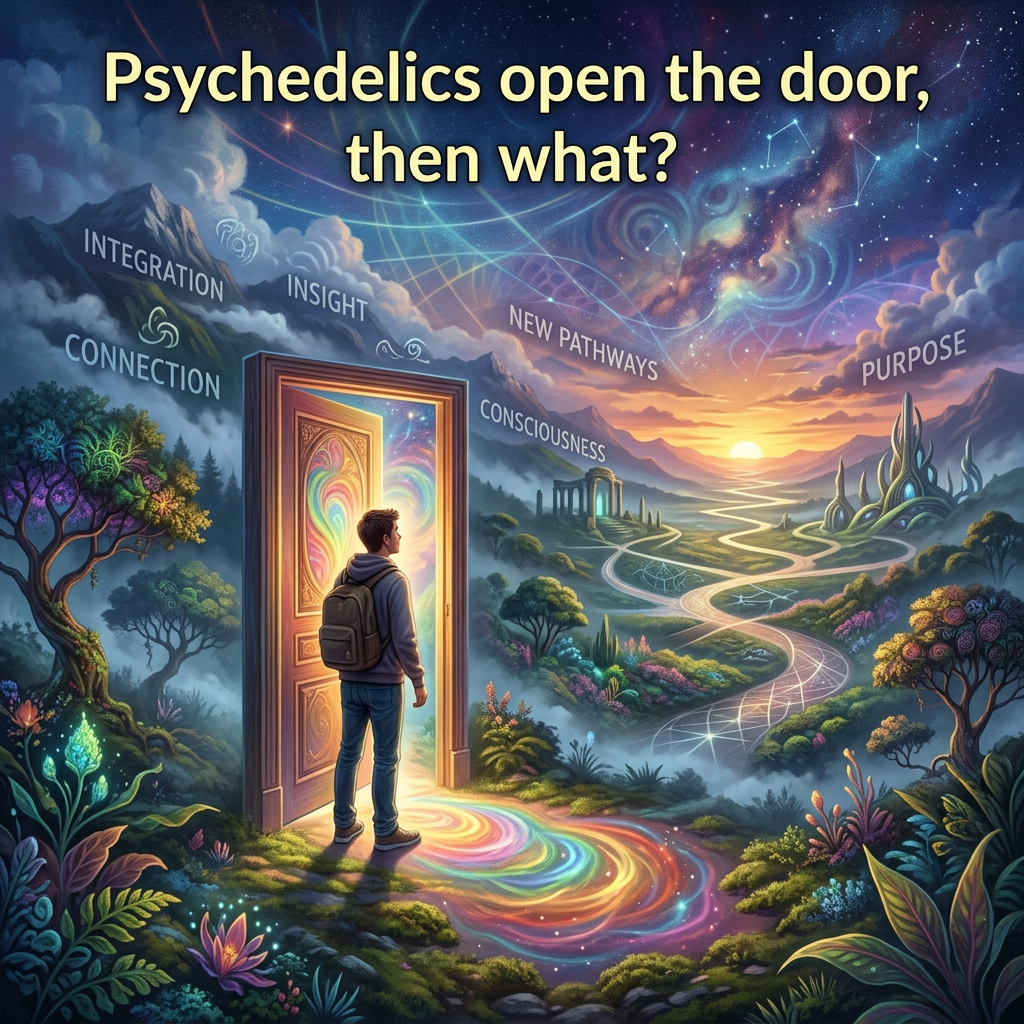
    Psychedelics Open the Door Then What?

    Someone left a comment on my YouTube channel a while back: “He doesn’t know anything, he’s just a new graduate.” Fair enough. I should probably update my profile.

    For the record, I’ve been practicing psychiatry for five years post-residency now, and to put it mildly, I’ve seen a few things. I’ve sat across from patients fighting depression that won’t lift, PTSD that won’t quiet, bipolar illness that won’t stabilize, and the often-forgotten but equally devastating problem of simply trying to live a daily life. In the most complex cases, I struggle right alongside them. It takes a real toll on both sides of the therapeutic relationship. I didn’t enter medicine, and certainly not psychiatry, to helplessly watch people suffer.

    How I Got Hooked (No Pun Intended)

    I remember attending my first American Academy of Addiction Psychiatry annual meeting with my best friend, two excited second-year residents with a budding interest in addiction medicine. There were dozens of strong lectures that week, but one track lit me up: a series on psychedelic research, including data on mystical experience and the use of psilocybin in patients with terminal cancer.

    I was hooked. The work was compelling, novel, and almost completely absent from the standard residency curriculum. The literature has only grown since, building on a body of clinical research and on centuries of indigenous and traditional experience that came long before any of us showed up to a conference.

    Why the Psychedelic Conversation Matters Now

    People have told me my entire field is “pseudoscience at best.” I prefer to think of psychiatry as the most interpretive part of medicine, but everyone is entitled to an opinion.

    What most people across the spectrum do agree on is this: collective mental health is getting worse, and the current standard of care leaves a lot of people out in the cold. There is a large gap, and it is begging to be filled. Right now, renewed clinical and cultural interest in psychedelics is rushing in to fill it.

    Everything old is new again. Postwar America saw a similar wave in the 1960s, a counterculture pushing back against the status quo with these compounds in hand, and we blew it. We were reckless, the political backlash was severe, and the scientific window slammed shut for a generation. We have a chance now to do this differently: to do the actual science, to understand these medicines, and to deliver them safely. I have written extensively about that elsewhere, and I will continue to.

    This piece is about something else.

    What I’ve Actually Seen in the Room

    After five years of treating serious mental illness, treatment-resistant depression, and addiction, here is the unglamorous clinical truth I want anyone considering psychedelic therapy to hear:

    I have rarely seen lasting recovery come from medication alone.

    Not on SSRIs. Not on mood stabilizers. Not on stimulants. And, this is the part the hype train usually skips, not on psychedelics either.

    Medication can take the edge off. It can crack a window in a sealed room. But without a concerted effort to change how a person thinks, what they believe about themselves, and how they show up in their own life, relief is often partial and temporary. Old patterns reassert themselves with depressing reliability.

    Being well, actually well, not just less symptomatic, is a far more complex process than adding a molecule. Even when that molecule is a powerful psychedelic that can temporarily reroute the circuits that have run a patient’s life into the ground.

    The Onion and the Ego

    This is where ego dissolution comes in.

    Psychedelics, used well, can do something extraordinary. They can peel back the layers, the conditioning, the wounds, the social performance, the inherited beliefs – and offer a person something close to a blank canvas. The experience is often described as a multi-stage journey: a descent into the subconscious, a confrontation with personal shadow material, and an ascent toward integration. Anyone who has sat with patients in the days after a session knows that structure is not imaginary.

    But dissolving the ego is only half the work. Maybe less.

    There has to be a rebuilding. Otherwise, the process can end in chaos, disorientation, drift, or destabilization. For all the cultural and societal programming embedded in the ego, the ego also has a job. It organizes. It protects. It gives a person a sense of continuous self. You do not want it gone so much as loosened, examined, and put back together with more skill.

    A Spiritual Problem in a Secular Age

    Here is where I will say something that may cost me a few subscribers: for many patients, psychedelic experiences can feel like a return to something sacred, however they define it.

    Nietzsche famously wrote, “God is dead. God remains dead. And we have killed him.” That line is usually quoted as a takedown of religion. I read it more as a diagnosis. Religious authority is not what it used to be, fine, but the bigger problem is the void it left behind. Not a physical void. An existential one. And that is much harder to fill.

    A great deal of suffering in modern mental health is not only symptomatic. It is existential. It is about disconnection, meaning, identity, and the felt sense that nothing larger is holding the pieces together. This is where psychedelics, used carefully, may do something SSRIs cannot. The mystical experience, that sense of being part of something larger, more connected, less small, is precisely what many patients are starving for. It offers a temporary transcendence of the cages we live inside and a reminder that the ego’s account of who we are is not the whole story.

    The Limitation Nobody Wants to Talk About

    Here is the catch, and it is a big one.

    Psychedelics can show us the possibility of what we could be and how the world could feel. They do not teach us how to embody that possibility once we come back down.

    It is like buying the book that is supposed to change your life, finishing it, and realizing it handed you the concept but not the protocol. The map, not the legs.

    In my view, this will be one of the central questions of the psychedelic revolution in both medicine and culture: when we strip away the layers that make us who we think we are, what do we replace them with?

    Will the medicine alone be enough? I do not think so. For people to genuinely transcend rigid thought patterns and live differently, something larger has to shift: a societal opening toward the slow work of integration, lived community, meaning-making, and the willingness to pursue some form of inner life without being constantly dragged back by money, politics, and a version of the American dream that has metabolized into burnout for much of the country.

    Without some broader change in how we live, think, and treat each other, psychedelic therapy risks becoming a high-end coping mechanism. People will dose, briefly touch something profound, and then return to the same conditions that drove the depression in the first place. So they will dose again. And again.

    What the Old-Timers Knew

    This is both a beacon of hope and a cautionary tale, and not from me. From the people who walked this path long before psychiatry got around to studying it. The medicines open the door. They do not walk you through it.

    The deepest insight – the one many patients eventually report after the sessions, the integration, and the work – is almost embarrassingly simple: the beauty of everyday life and ordinary connection was already there. The medicine just got the ego out of the way long enough to let them see it.

    The work, your work, my work, our work, is figuring out how to keep seeing it once the medicine wears off.

  • The psychedelic conversation in psychiatry is at an inflection point

    The psychedelic conversation in psychiatry is at an inflection point

    I believe these treatments deserve serious study. In fact, some of the most promising work in modern psychiatry is happening in this space. Psilocybin has FDA breakthrough therapy designation for treatment-resistant depression, MDMA-assisted therapy has shown meaningful promise in PTSD, and ibogaine is generating legitimate research interest in opioid use disorder and traumatic brain injury. 

    But promise is not proof.

    In my new Psychiatric Times article, I make the case that psychedelics deserve real science, not political shortcuts, podcast-driven enthusiasm, or regulatory acceleration built on weak evidence. The core issue is not whether we should study these compounds. We should. The issue is whether observational data, open-label studies, and viral claims are being asked to carry more weight than they should. 

    When a treatment has real risks, especially one like ibogaine with known cardiac concerns, the answer cannot be to lower the evidentiary bar. It has to be to raise the quality of the research. That means adequately powered randomized trials, careful safety monitoring, standardized outcomes, and enough humility to admit what we do not yet know. 

    Psychiatry does need better tools. Our patients need them badly. But if we want innovation that lasts, it has to be built on rigor, not hype.

    My latest piece in Psychiatric Times“Psychedelics Deserve Real Science”

  • We say we care about mental health in America

    We say we care about mental health in America

    We say we care about mental health in America.
    But the data—and my front-line experience—say otherwise.

    We are overmedicating, underfunding, and pathologizing poverty, trauma, and stress.
    Instead of addressing why people are sick, we throw pills at symptoms.

    🧠 In my latest article for Psychiatric Times, I make the case that we’ve built a system that profits off disease—not health.
    We’re not solving the problem. We’re institutionalizing it.

    If we want to make America healthy again, we need to stop doing the wrong things.

    👉 Read the full piece here: https://www.psychiatrictimes.com/view/if-we-want-to-make-america-healthy-again-we-are-doing-the-wrong-thing

  • Is Antidepressant Withdrawal Overhyped? What the Evidence Really Says

    Is Antidepressant Withdrawal Overhyped? What the Evidence Really Says

    In my clinical practice, I’ve often found myself scratching my head over the narrative surrounding antidepressant withdrawal.

    I’m not denying that withdrawal is real—it is. And for a small subset of patients, it can be quite distressing. But what I am saying is this: it’s not nearly as common, dramatic, or dangerous as some online circles and sensational stories would have you believe.

    I’ve seen countless patients abruptly stop antidepressants and experience no withdrawal symptoms. I’ve also aggressively tapered antidepressants in patients with bipolar disorder to prevent mood destabilization—again, with little to no evidence of withdrawal. This isn’t a one-off observation. It’s a consistent clinical pattern I’ve noted for years. So, I asked myself: What does the data actually say?

    The Evidence

    A 2024 meta-analysis published in JAMA Psychiatry examined 49 randomized controlled trials and finally gave us some clarity.

    The results?
    ✅ People discontinuing antidepressants reported on average just one more symptom than those who either continued medication or discontinued a placebo.
    ✅ The most commonly reported symptoms in the first two weeks were dizziness, nausea, vertigo, and nervousness—exactly what I’ve seen clinically.
    ✅ Critically, the average number of symptoms fell below the threshold for what’s considered a clinically significant discontinuation syndrome.
    ✅ There was no link between discontinuation and worsening depression, suggesting that if mood symptoms return, it’s likely a relapse—not withdrawal.

    Why This Matters

    There are vocal groups online—often with clear anti-psychiatry agendas—who focus exclusively on rare, severe cases of withdrawal and present them as the norm. The goal is simple: to scare people away from psychiatry and evidence-based treatment using emotional testimonials instead of clinical reality.

    Let’s be honest—those cases do exist, but they are not representative of what most patients experience.

    As clinicians, we should remain cautious and responsible. Yes, we should taper medications thoughtfully. Yes, we should prepare patients for the possibility of withdrawal symptoms. But we also shouldn’t scare them into avoiding treatment—or make them feel trapped on medications for life.

    Bottom Line

    Antidepressant withdrawal can happen. It can be uncomfortable. But it’s rarely severe and almost never dangerous. The fear around it has been overstated by those with an ax to grind. We owe it to our patients to treat based on evidence, not anecdotes.

  • Brexpiprazole + Sertraline: A New Hope for PTSD Treatment

    Brexpiprazole + Sertraline: A New Hope for PTSD Treatment

    We’ve all seen it: PTSD that won’t budge. Patients try sertraline or paroxetine—the so-called “gold standards”—and walk away with little more than side effects and a sense of failure.

    Enter a new contender: brexpiprazole + sertraline.

    A recent Phase 3 randomized controlled trial might finally offer something real for those stuck in the PTSD trenches.

    🚨 The Results

    In a study across 86 sites with over 550 adults, adding brexpiprazole (2–3 mg) to sertraline (150 mg) led to a 5.6-point greater reduction on the CAPS‑5 (the gold-standard PTSD measure) compared to sertraline + placebo. That’s not a marginal win—it’s a clinically significant shift, especially in a treatment-resistant population.

    Responder rates tell the story even clearer:

    • 68.5% of patients on the combo had ≥30% reduction in symptoms
    • Compared to 48.2% on sertraline alone
    • That’s a +20% absolute response rate boost

    And the improvements weren’t just short-lived. Benefits held through 12 weeks, even during a post-treatment observation period. No relapse, no rebound—just stability.

    🧩 More Than Symptom Checklists

    It wasn’t just about PTSD symptoms. This combo also:

    • Improved psychosocial functioning (B-IPF scores)
    • Reduced anxiety and depression (HADS)
    • Lowered global illness severity (CGI-S)
    • Helped with all symptom clusters, including reexperiencing, avoidance, and hyperarousal

    That’s rare. Most meds in psychiatry hit one or two domains and leave the rest hanging. This one made a dent where it counts: function, resilience, and real-world relief.

    ⚠️ What About Side Effects?

    Brexpiprazole is still an atypical antipsychotic, so there’s baggage. But the trial data suggest it’s relatively well-tolerated:

    • Fatigue: 6.8%
    • Weight gain: 5.9%
    • Somnolence: 5.4%
    • Discontinuation due to AEs? Just 3.9%, vs 10.2% in placebo.

    No new safety signals. No psychosis worsening. Not perfect, but not the metabolic disaster zone we see with other agents.

    🚀 What’s Next?

    The FDA is reviewing this combo

    For those of us treating chronic PTSD, this may be a real tool—not just a shiny new molecule with good marketing.

    Until then, it’s worth paying attention. Because when sertraline alone doesn’t cut it—and we know it often doesn’t—this combo could offer a lifeline.