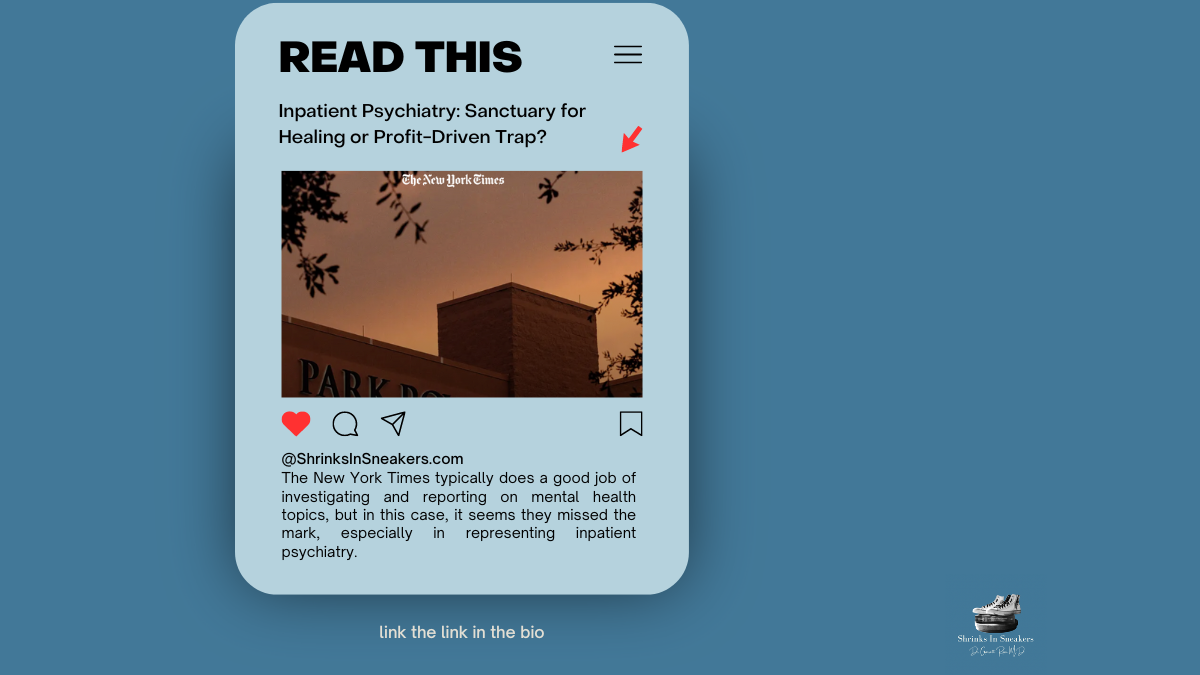
The New York Times typically does a good job of investigating and reporting on mental health topics, but in this case, it seems they missed the mark, especially in representing inpatient psychiatry. Inpatient psychiatry is a challenging environment for both patients and physicians like myself. We never want to keep anyone in the hospital who doesn’t need to be there. In fact, when patients accuse me of holding them for financial gain, I tell them that I’m paid the same regardless of the number of cases I manage, and my life is easier with fewer patients. No physician working in inpatient care would ever keep someone confined without a legitimate safety concern for the patient or the community. While no one defends poor practices, and Arcadia may indeed have its issues, the broader implications of articles like this one deserve closer scrutiny. The article lacks detail, avoids expert input from professionals in the field, and fails to account for the fact that dangerousness might emerge during hospitalization, potentially converting a voluntary patient to involuntary status or necessitating a more cautious discharge approach that could save lives.
Here’s the reality: people are admitted to inpatient psychiatric units for a variety of reasons. We can talk all day about the broken U.S. healthcare system and the lack of access to quality outpatient psychiatric care, but fundamentally, there are two main reasons someone ends up on an inpatient unit. First, they are a danger to themselves, and without close monitoring and treatment, they are at high risk of suicide. Second, they pose a danger to others, and without inpatient care, serious harm could come to someone else. We see plenty of cases that meet these clear criteria, and I believe that without our services, many of these individuals would either be dead or in jail. However, there are also other reasons why patients seek inpatient care, and the article’s example of a woman with bipolar disorder needing a medication adjustment is worth exploring.
Why not see an outpatient psychiatrist for medication management? Why seek inpatient care from a doctor who doesn’t know your case? This situation can be dissected further. Suppose this patient, who doesn’t pose a threat to themselves or others, voluntarily enters an inpatient unit for treatment. Medication changes are made, lithium is increased, and as the treating physician, you would need at least 3-5 days for observation and lab work to monitor the effects. Given that this patient could have pursued outpatient treatment, it becomes your responsibility as the inpatient doctor to ensure proper monitoring and follow-up. But let’s say, after admission, you learn that the patient had been suicidal the week prior and had a plan to overdose. Now, there’s new information indicating a greater level of risk. If, after 24 hours, the patient suddenly wants to leave, as the physician, you must consider this new information. You ask to speak to the patient’s family to gather more context, but the patient refuses and demands discharge. In my state, the patient would file a formal 48-hour notice, which allows me 48 hours to assess if they pose an imminent danger. If so, a two-physician commitment process can be initiated.
The point is that treating physicians must weigh numerous safety concerns—such as unfinished medication adjustments, potential emerging risks, and patients’ misunderstanding of the inpatient process. Mental health treatment often takes weeks to months to see full results, and if patients feel significantly better after just a few days, it’s either due to electroconvulsive therapy (ECT) or the placebo effect of being in a hospital setting. I believe it’s crucial for people to understand the role of inpatient psychiatric facilities, and I make it a point to educate my patients about why hospitalization is necessary and what they can expect. Many arrive with false assumptions about what can be accomplished in an inpatient setting.
Link to New York Times Article: https://www.nytimes.com/2024/09/01/business/acadia-psychiatric-patients-trapped.html