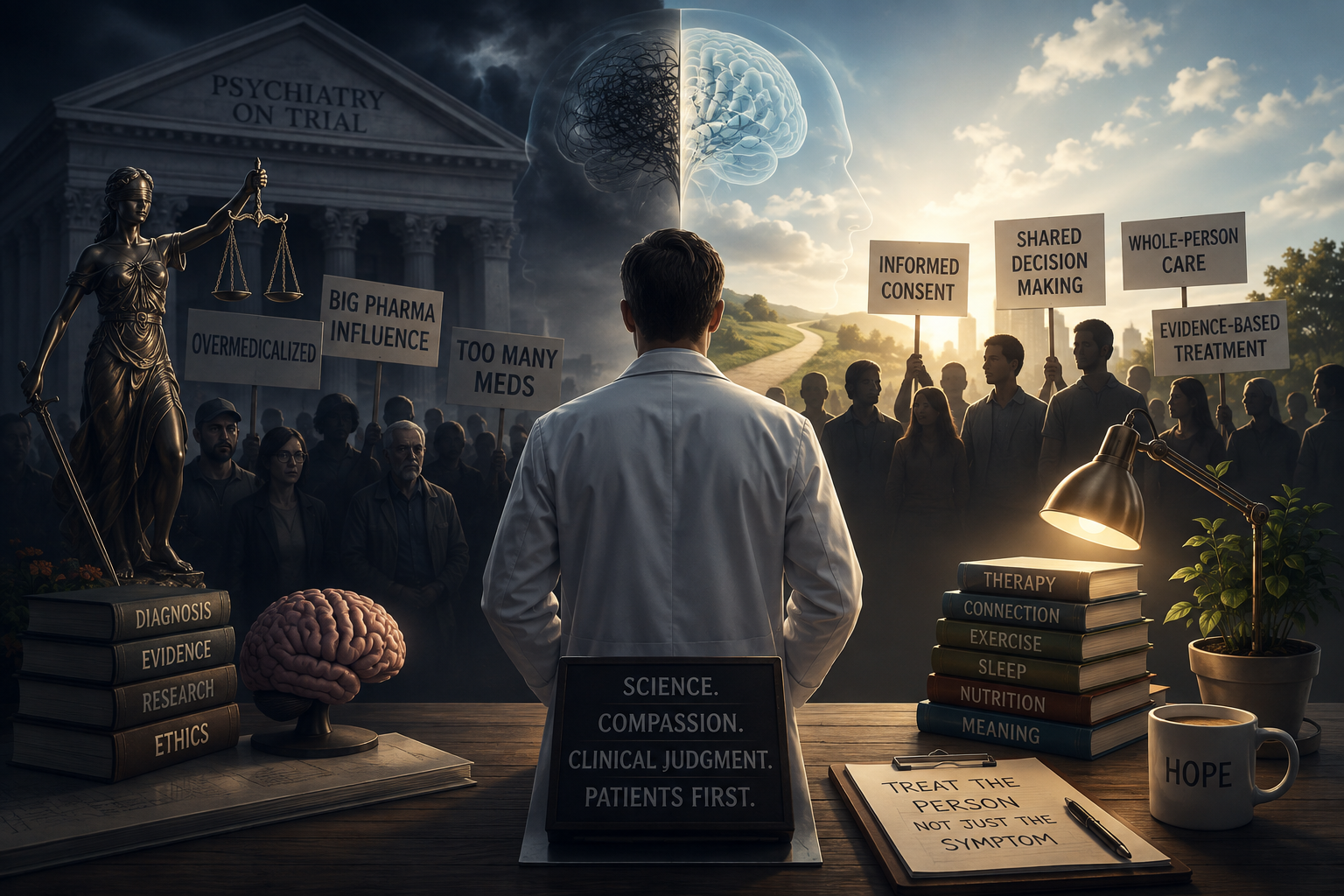
Psychiatry is on trial. It was probably inevitable. A field that treats suffering, suicide, psychosis, trauma, addiction, violence risk, loneliness, despair, and meaninglessness was always going to be dragged into the political arena. Psychiatry sits at the intersection of medicine, culture, family trauma, public fear, pharmaceutical influence, personal liberty, and moral injury. That makes it uniquely vulnerable to distortion.
But the current moment feels different.
With Health and Human Services Secretary Robert F. Kennedy Jr. placing psychiatric medications and “overmedicalization” at the center of federal attention, psychiatry is no longer only being debated in journals, clinics, and academic conferences. It is being litigated in public. Increasingly, it is also being litigated in court. On May 4, 2026, HHS announced a MAHA action plan aimed at curbing psychiatric overprescribing, promoting informed consent, shared decision-making, nonmedication interventions, and deprescribing when clinically indicated.1
Some of that language is reasonable. In fact, many psychiatrists already agree with it.
Psychiatric medications should not be the default response to every form of human distress. Patients deserve informed consent. Deprescribing should be part of competent care. Psychotherapy, exercise, sleep, nutrition, family support, social connection, and meaning making should not be treated as decorative add-ons. They are often central to recovery.
But that is not the same as saying psychiatric illness is not real. It is not the same as implying psychiatric medications are broadly dangerous, unnecessary, or responsible for America’s mental health crisis. And it is certainly not the same as turning painful anecdotes into national policy.
That is where psychiatry must draw the line.
The American Psychiatric Association has appropriately pushed back on the idea that the mental health crisis can be reduced to overprescribing, noting that this framing ignores workforce shortages, limited access to care, lack of psychiatric beds, and uneven distribution of evidence-based treatment.2 That is exactly right. Deprescribing may be good medicine in selected cases. But deprescribing is not a national mental health strategy.
It is a clinical tool.
There is a dangerous pattern in the current conversation. A public figure describes a deeply personal experience: a family member struggles to discontinue an antidepressant, someone feels emotionally blunted on medication, a young adult regrets being started on an SSRI as a teenager, or a patient develops withdrawal symptoms after stopping too quickly. The story is real. The suffering is real. The problem deserves attention.
But then the anecdote becomes a theory of psychiatry.
The assumption becomes: because this happened to someone I love, this must be what psychiatry is doing to the country.
That is not science. That is narrative capture.
Psychiatry should not dismiss these stories. We should listen to them. We should admit that antidepressant discontinuation can be difficult for some patients. We should acknowledge that medications are sometimes started without a clear enough plan, continued without adequate review, and stopped too abruptly. We should be honest that some patients are placed on medication when what they needed first was psychotherapy, time, structure, sleep, exercise, substance use treatment, grief work, family intervention, or a change in environment.
But honesty cuts both ways.
Some patients are not “overmedicalized.” They are undertreated. Some are not being harmed by psychiatry. They are being harmed by the absence of psychiatry. Some patients do not need fewer medications. They need the right diagnosis, the right medication, the right dose, the right monitoring, the right therapy, and a system that does not abandon them after discharge.
I work in real-world psychiatry. I have seen patients whose lives were devastated by undertreated depression, bipolar disorder, psychosis, catatonia, OCD, addiction, and trauma. I have also seen patients placed on medications they did not need, for longer than necessary, without enough discussion about risks, benefits, alternatives, or exit strategies. Both realities are true.
That is the entire point.
Psychiatry’s critics often want one story. The real world gives us several.
Psychiatric medications can be overused. They can also be lifesaving.
Antidepressants can cause side effects. They can also help patients return to work, reconnect with family, survive suicidal depression, and function again.
Stopping medication can produce withdrawal symptoms. Stopping medication can also reveal relapse of the underlying illness. Clinically, those are not always easy to separate, and the distinction matters.
Psychiatry has a difficult history. It also remains one of the few medical specialties willing to sit with the most frightening, stigmatized, and disabling forms of human suffering.
The field does not need denial. It needs precision.
One of the most important reforms psychiatry should embrace is building the off-ramp into treatment from the beginning. When starting an antidepressant, clinicians should discuss expected duration, criteria for continuation, warning signs of relapse, tapering principles, and what remission means. Patients should know that medication is not a moral failure, not a life sentence, and not something to stop abruptly to prove toughness.
Abrupt discontinuation is not courage. It is usually bad medicine.
And it is not only psychiatrists saying so. The American Foundation for Suicide Prevention, responding directly to the HHS action plan, warned that “abrupt discontinuation or inappropriate ‘deprescribing,’ particularly outside a collaborative patient-provider process, can increase risk, including the potential for symptom relapse and elevated suicide risk for some individuals.”3 AFSP also reaffirmed what decades of clinical trials, population-level studies, and health system data have shown: judicious use of antidepressants reduces suicide risk overall.3
That is the suicide prevention community speaking. Not the pharmaceutical industry. Not organized psychiatry. The organization whose entire mission is keeping people alive.
If HHS wants to support better tapering education, better informed consent, better access to psychotherapy, and better reimbursement for clinicians who take the time to deprescribe carefully, psychiatry should welcome that. In fact, we should lead it. The HHS action plan specifically emphasizes informed consent, shared decision-making, review of risks and benefits, nonmedication approaches, and tapering when patients are not experiencing clinical benefit.1 Those are not anti-psychiatry principles. Done correctly, they are good psychiatry.
But the same public conversation has also entertained the claim that psychiatric medications cause mass shootings, a claim that has been repeatedly examined and found to lack credible scientific support. When prominent voices repeat it anyway, the harm is not abstract. Patients hear it. Families hear it. Lawmakers hear it. People already afraid of treatment become more afraid. Stigma grows. Care is delayed.
And delayed care kills. AFSP said as much in its response to this action plan.3
Psychiatry should not respond to this moment by becoming reflexively defensive. We should not pretend the field has always gotten it right. We have not. We should not deny withdrawal, side effects, diagnostic uncertainty, pharmaceutical influence, rushed prescribing, or the medicalization of ordinary distress. Those criticisms contain enough truth that ignoring them would be a mistake.
But we should also refuse to accept a false indictment.
The problem is not that psychiatry exists. The problem is that too many Americans receive fragmented, rushed, algorithmic, poorly monitored, under-resourced mental health care and then call that psychiatry.
The problem is not that antidepressants are prescribed. The problem is that they are sometimes prescribed without enough diagnostic clarity, psychotherapy access, follow-up, deprescribing planning, or attention to the difference between illness and distress.
The problem is not that psychiatrists believe in medication. The problem is that our health care system often reimburses medication management more reliably than psychotherapy, family work, lifestyle intervention, prevention, community support, and time.
That is not an argument against psychiatry. It is an argument for better psychiatry.
Psychiatry must be willing to say something politically inconvenient: not all suffering is mental illness, but mental illness is real. Not everyone who is sad needs a diagnosis, but some people with depression will die without treatment. Not every anxious child needs medication, but some children are severely impaired and deserve evidence-based care. Not every patient should remain on an antidepressant indefinitely, but some patients relapse repeatedly when treatment is stopped. Not every psychiatric outcome is preventable, but some bad outcomes occur because systems fail.
It is possible to do everything right in psychiatry and still have a tragic outcome.
It is also possible to have a tragic outcome because we did not do enough.
That distinction is where serious medicine lives.
This is why psychiatry must reclaim the public narrative. We cannot allow the field to be defined only by its critics, by pharmaceutical marketing, by political theater, or by the most extreme anecdotes on social media. We need to speak plainly to the public.
Yes, antidepressant withdrawal can happen.
Yes, some patients are overmedicated.
Yes, informed consent needs to improve.
Yes, therapy and lifestyle interventions matter.
Yes, deprescribing should be part of psychiatric competence.
And yes, psychiatric medications remain essential treatments for many people with serious and disabling illness.
The future of psychiatry should not be pill-first. It should not be pill-never. It should be patient-first, diagnosis-first, evidence-first, and humility-first.
Psychiatry will not survive this moment by going quiet, and it will not survive it by going defensive. It will survive by becoming better, and by saying so out loud.
We are not the cause of America’s mental health crisis. We are also not its cure. We are physicians treating the most disabling illnesses medicine has ever named, in a system that has never funded us to do it well, in a country that wants the suffering to stop but does not want to pay for the treatment that stops it.
If HHS wants better psychiatry, psychiatry should be the first to demand it. If patients want safer prescribing, we should be the ones leading it. If the public wants honesty, we should give them more of it than they expected.
Psychiatry does not need to plead guilty to the wrong charges. But we do need to stop letting other people write the indictment.
The defense rests when the work begins.
References
1. HHS launches MAHA action plan to curb psychiatric overprescribing. US Department of Health and Human Services. News release. May 4, 2026. Accessed May 13, 2026. https://www.hhs.gov/press-room/hhs-launches-maha-action-plan-curb-psychiatric-overprescribing.html
2. APA welcomes national focus on mental health, urges evidence-based approach and continued focus on access to care. American Psychiatric Association. News release. May 4, 2026. Accessed May 13, 2026.
3. Moutier CY. AFSP statement on the importance of antidepressants and evidence-based treatment for suicide prevention. American Foundation for Suicide Prevention. News release. May 5, 2026. Accessed May 13, 2026. https://www.prnewswire.com/news-releases/afsp-statement-on-the-importance-of-antidepressants-and-evidence-based-treatment-for-suicide-prevention-302762738.html
4. Espí Forcén F, Hatters Friedman S. Psychiatry on trial: are psychiatrists responsible for their patients’ criminal behavior? Psychiatric Times. August 27, 2026. Accessed August 29, 2026. https://www.psychiatrictimes.com/view/psychiatry-on-trial-are-psychiatrists-responsible-for-their-patients-criminal-behavior
Disclaimer: Views are my own not associated with any employer. This is not medical advice, and the information is provided for educational purposes only. Please consult your doctor for any specific medical questions. All content is created for informational purposes only. The Content is not intended to be a substitute for professional medical advice, diagnosis, or treatment. Always seek the advice of your physician or other qualified health provider. If you think you have a medical emergency, call your doctor, go to the emergency department, or call 911. We do not endorse any specific treatment, tests, or procedures. Reliance on this information is solely at your own risk.