Tag: medical training

  • Your Day Job Does Not Have to Be Your Life’s Work

    Your Day Job Does Not Have to Be Your Life’s Work

    Why doctors and probably everyone else need work that belongs to them

    Seeing patients all day was never my favorite way to use my skills.

    Even writing that sentence feels strangely uncomfortable. Physicians aren’t supposed to say things like that. We spend more than a decade training to take care of patients. We sacrifice our twenties, accumulate debt, miss weddings, work nights, weekends, and holidays, and build an enormous amount of our identity around becoming a doctor.

    So, once you finally become one, shouldn’t patient care be the thing that gives you the greatest sense of meaning and fulfillment?

    Maybe.

    But what if it isn’t?

    And what if there is nothing particularly wrong with that?

    One of Medicine’s Quiet Expectations

    I enjoy psychiatry. I care deeply about doing good clinical work. I want the people I treat to get better.

    But if you asked me what activities make me lose track of time, they usually aren’t the routine parts of clinical medicine. They are reading. Writing. Teaching. Going down an intellectual rabbit hole because I came across an idea I don’t understand. Reading an old psychiatry paper and wondering why we stopped thinking about the problem that way. Taking something complicated and figuring out how to explain it so another person can actually use it.

    Those have always been some of the most meaningful parts of my life.

    And for years, I almost felt guilty about that.

    There is an unspoken belief in medicine that the ideal physician should receive nearly unlimited emotional and intellectual nourishment from direct patient care. Anything else can sound selfish.

    You want to write? Fine, if you see your patients first.

    You want to teach? Great, if it doesn’t interfere with productivity.

    You want to research an obscure idea, create educational content, study philosophy, build something, or spend three hours thinking about a question nobody assigned you?

    That’s a hobby. Get back to work.

    Then I Heard Someone Say It Out Loud

    Recently, psychiatrist Nassir Ghaemi described an idea during his commencement address to the 2026 Yale psychiatry residency class that immediately resonated with me.

    He called it having a “night job.”

    Your day job is the work you are paid to do. Your night job is the work that satisfies something deeper.

    As Ghaemi put it: “Many people are dissatisfied because their day job doesn’t satisfy them emotionally or intellectually.”

    That doesn’t necessarily mean your day job is bad. It means we may be asking far too much of it.

    We expect a single profession to provide income, identity, purpose, intellectual stimulation, emotional fulfillment, social connection, prestige, and happiness. That is an enormous burden to place on a job. And when it inevitably fails to provide all those things, we conclude that something must be wrong.

    Maybe we chose the wrong specialty. Maybe we are burned out. Maybe medicine has changed. Maybe we aren’t as dedicated as everyone else.

    Sometimes those explanations are true.

    But sometimes your job is simply your job. It can be important. You can be good at it. You can care deeply about doing it well.

    And it still doesn’t have to satisfy every part of you.

    The Night Job

    The term “night job” is a little misleading, because this isn’t about staying up until midnight working on another project. It isn’t another version of hustle culture. The goal isn’t to finish a twelve-hour clinical day and then punish yourself with four more hours of productivity.

    The night job is the parallel pursuit that belongs to you.

    For me, that has meant writing, teaching, and creating — studying psychology, philosophy, neuroscience, and human behavior far outside the narrow boundaries of daily clinical practice. Trying to understand not simply what the treatment guidelines tell us to prescribe, but why people suffer, why treatments work, why they fail, and what we may be getting wrong.

    And then taking those ideas and sharing them.

    That’s a large part of why I created Shrinks in Sneakers. I wanted to talk about psychiatry the way clinicians experience it. I wanted to explain treatments without pretending the evidence is cleaner than it really is. I wanted to challenge conventional wisdom when the conventional wisdom didn’t make sense. And I wanted ordinary people to have access to high-quality psychiatric education without needing a medical degree to understand it.

    Nobody assigned me that job. For most of it, nobody paid me.

    I did it because I couldn’t imagine not doing it.

    That’s the difference.

    Your Greatest Work May Not Be the Work Someone Hired You to Do

    This is the part I think young physicians need to hear.

    Your career does not have to fit neatly inside your employment contract.

    Medicine has become very good at defining our value through measurable units. Patients seen. Notes completed. RVUs generated. Charts closed. Quality metrics achieved. Those things may be necessary to operate a healthcare system.

    But they are terrible measurements of a human life.

    Some of the most important work you ever do may have no billing code. It may be the paper you write because an observation bothered you. The lecture you build because nobody ever taught the topic correctly. The student you mentor. The podcast nobody listens to for the first year. The book sitting half-finished on your computer. The research questions your institution doesn’t care about. Or simply the subject you study because understanding it makes you feel alive.

    Your employer may never reward you for it. The world might not reward you for it either.

    Do it anyway.

    But there is a catch

    There is one major problem with the night job.

    Energy.

    After a full clinical day, there isn’t always much left. This is where I think the idea needs an important modification:

    Protect your best energy for at least some of the work that matters most to you.

    Don’t automatically give your employer every productive hour you have and reserve whatever exhausted fragments remain for the things you supposedly care about most.

    Sometimes that means writing before work. Reading for an hour in the morning. Blocking off an afternoon. Saying no to another committee. Doing slightly less of something that doesn’t matter so you can do more of something that does.

    Ghaemi described doing something similar — stopping at a café before reaching the hospital so he could write while his mind was still fresh. That makes far more sense to me than glorifying exhaustion.

    The night job shouldn’t shrink your life.

    It should make your life bigger.

    You Are Allowed to Be More Than Your Profession

    Medicine has a strange way of consuming identity. First, you are a premed. Then a medical student. Then a resident. Then an attending. Eventually somebody asks who you are, and without realizing it, you answer with your specialty.

    “I’m a psychiatrist.”

    True. But incomplete.

    I’m also someone who writes. Someone who teaches. Someone who creates. Someone who is endlessly curious about why human beings do the things they do. Being a psychiatrist gives me an extraordinary vantage point from which to explore those questions.

    It doesn’t need to be the boundary around them.

    Take your work seriously. Treat people well. Become excellent at whatever profession you choose. But you do not have to surrender the rest of yourself to your job.

    Find the thing you would keep doing even if nobody put it on your performance review. Find the subject you read about when nobody assigned the chapter. Find the work that makes two hours feel like twenty minutes.

    Then build some space for it.

    Call it your night job. Call it a side project. Call it your life’s work. The name isn’t important.

    What matters is recognizing that the work that pays for your life and the work that gives your life meaning do not have to be the same thing.

    And maybe we would all be a little happier if we stopped pretending they did.

    Psychiatry Unfiltered
  • Understanding Psychiatry: Science vs. Skepticism

    Understanding Psychiatry: Science vs. Skepticism

    🧠 “Psychiatry is a scam.” “Big Pharma controls your brain.” “Mental illness isn’t real.”

    You’ve heard the takes. Now here’s the truth.

    In my new article for Psychiatric Times, I dive headfirst into the controversy:
    👉 Understanding Psychiatry: Navigating Skepticism and Science
    https://www.psychiatrictimes.com/view/understanding-psychiatry-navigating-skepticism-and-science

    I don’t dodge the hard questions—about overmedication, broken trust, and bad science—but I also push back against lazy anti-psychiatry takes that ignore the very real suffering of patients.

    If you care about the future of mental health care, this one’s worth your time.

  • The Silent Crisis: Physician Suicide in the United States

    The Silent Crisis: Physician Suicide in the United States

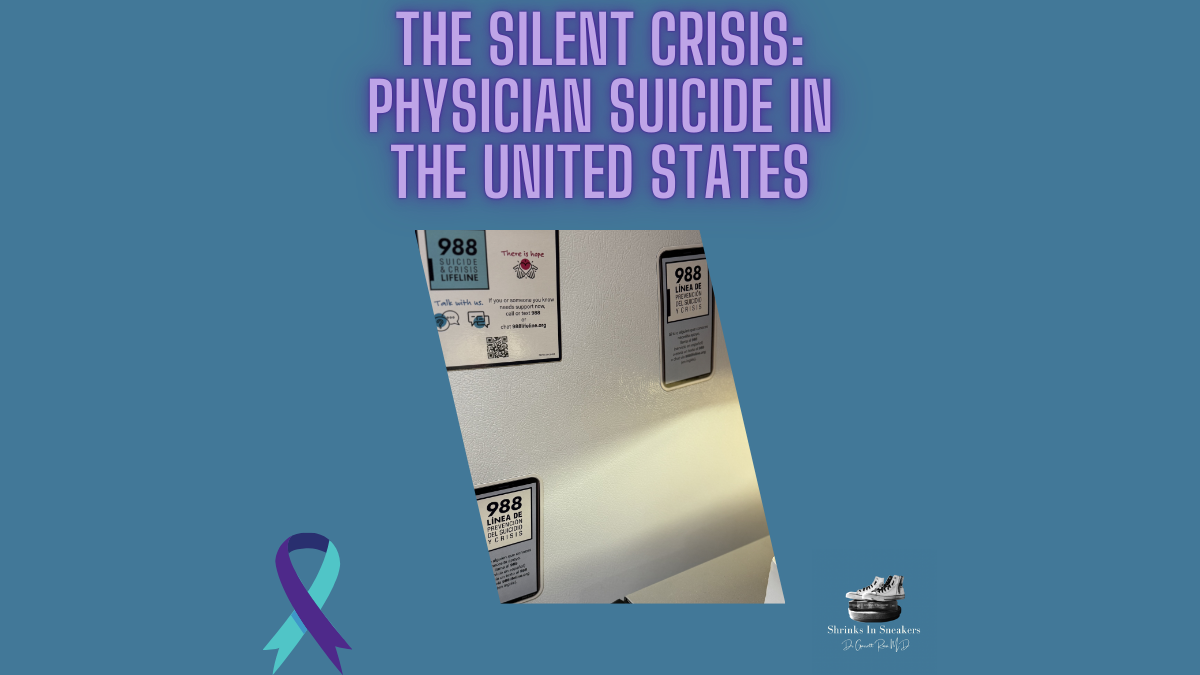
    I saw these magnets today on the refrigerator located in the physicians lounge and it seemed like a good reminder 

    In the U.S., an estimated 300-400 physicians die by suicide each year, a staggering rate far higher than that of the general population. This crisis, largely unspoken in healthcare settings, underscores the immense pressures physicians face daily. The high expectations, long hours, emotional exhaustion, and the stigma around seeking mental health support create a dangerous environment where burnout can quickly spiral into severe mental health struggles.

    Physicians are trained to endure, often putting others’ health before their own. But the costs of “pushing through” take a toll. Many feel they cannot safely reach out for help without risking their careers due to institutional stigma around mental health treatment. This cycle of isolation and suppressed emotion can lead to tragic outcomes.

    Organizations are beginning to address this issue by implementing wellness programs, peer support systems, and confidential mental health resources, but more systemic changes are needed. Reducing the stigma around mental health support, reforming punitive policies, and fostering a culture of openness in medicine could be life-saving.

    Physician suicide affects us all—it robs the healthcare system of dedicated professionals and leaves profound impacts on patients, families, and communities. It’s time to break the silence and actively support those who care for us.

  • The parallels between the psychiatric asylums and modern inpatient psychiatric treatment 

    The parallels between the psychiatric asylums and modern inpatient psychiatric treatment 

    The history of psychiatric asylums is a dark chapter in mental health care, yet the more I reflect on it, the more I see troubling parallels between the asylum era and our modern system of inpatient psychiatric treatment.

    Asylums, in their earliest forms, were created with good intentions: to provide care for those with severe mental illnesses and intellectual disabilities who could not be safely or adequately treated in their communities. However, as these institutions became overcrowded, underfunded, and poorly staffed, they devolved into places of neglect, abuse, and suffering. The eventual closures of these institutions were a necessary response to the horrific conditions exposed, but the underlying issues didn’t disappear. They merely shifted.

    Today, many of the same challenges persist in our modern inpatient psychiatric system. Patients with severe mental illnesses or disabilities still require long-term care, but instead of asylums, they are placed in short-term facilities. These hospitals are often understaffed and overburdened, operating under financial pressures to prioritize quick turnover rather than long-term recovery. It’s not uncommon for patients to be admitted, stabilized just enough for discharge, and then readmitted within weeks—sometimes even days—because the core issues remain unaddressed.

    In both the asylums of the past and the short-term psychiatric hospitals of today, patients often receive the same types of medications and therapies. The difference is that today’s treatment settings operate under stricter legal frameworks aimed at preserving patient rights, but the lack of continuity and depth in treatment results in a revolving door of care. Rather than focusing on sustained recovery, the focus is often on crisis management and meeting insurance-imposed timelines.

    This cycle is problematic for patients and clinicians alike. For patients, it results in frustration, instability, and a lack of meaningful progress. For healthcare workers, it leads to burnout, similar to what was seen in the asylum era. The system, despite its modern façade, hasn’t evolved enough to address the long-term needs of individuals with severe mental illnesses. Until we invest in creating a system that prioritizes long-term, comprehensive care, we risk repeating the mistakes of the past—only this time without the walls of the asylum to contain the issue.

  • Surge in Antidepressant Overdoses Alarms Health Experts Across the U.S

    Surge in Antidepressant Overdoses Alarms Health Experts Across the U.S

    Rising Antidepressant Overdoses: A Growing Concern in the U.S.

    Recent data reveals that antidepressant overdoses in the U.S. have been steadily increasing from 1999 through 2022. According to a CDC report released last month, there were 5,863 overdose deaths attributed to antidepressants in 2022—numbers comparable to heroin-related fatalities, which claimed 5,871 lives. While these figures represent a small fraction of the over 100,000 overdose deaths that year—most of which involved fentanyl—they signal a troubling trend that demands attention.

    Potential Causes for the Rise in Antidepressant Overdoses

    Understanding the root causes of this increase is challenging, given the complexity of overdose data and the lack of detail on the exact substances involved. However, there are several factors worth considering.

    First, many individuals with opioid use disorder (OUD) also suffer from co-occurring mental health conditions like depression and bipolar disorder. These patients are often prescribed antidepressants, sometimes too liberally, in my experience working in community mental health. When opioids are mixed with antidepressants, opioids are often the primary cause of death in overdoses. Yet, I’ve also encountered numerous patients who have attempted suicide using antidepressants alone.

    Newer antidepressants are generally safer in overdose compared to older drugs, such as monoamine oxidase inhibitors (MAOIs) and tricyclic antidepressants (TCAs). While these older medications tend to be more effective, they come with significantly higher risks in overdose situations. This is something I frequently emphasize to residents: older drugs are more dangerous, but the newer ones, though safer, can still have serious consequences.

    Chronic pain patients, who are often prescribed opioids, are another vulnerable group. Their risk of suicide is heightened by the constant pain they endure, and many of these individuals are also prescribed antidepressants like duloxetine, which is indicated for pain management, or more dangerous TCAs such as amitriptyline and nortriptyline. Additionally, gabapentin—another drug commonly prescribed to these patients—has been known to increase the risk of death when taken with opioids.

    Overprescription of Antidepressants: A Contributing Factor?

    There has also been a sharp rise in antidepressant prescriptions across the U.S., which I believe warrants scrutiny. Antidepressants are, at best, symptom management tools, with a modest effect size of 0.33 in many studies. Given these limited benefits, we should be more judicious about who we prescribe these medications to and for how long.

    Withdrawal symptoms from long-term—and sometimes even short-term—use of antidepressants can be severe, increasing the risk of suicide. I’ve personally seen this with a family member who experienced debilitating headaches and vertigo after stopping sertraline. She was unable to work or function for nearly two weeks, highlighting how challenging withdrawal can be for some patients.

    Balancing Risks and Benefits in Mental Health Treatment

    Any population for whom antidepressants are considered a treatment option is inherently at high risk for suicide. That said, there are many confounding factors in the overdose data, and mainstream mental health reporting often glosses over the nuances of psychiatric research and treatment. When prescribing medications, it’s crucial to weigh not only the pros and cons of the drugs themselves but also to tailor treatment to each individual’s unique needs.

    I continue to prescribe antidepressants to patients whom I’ve carefully evaluated and believe will benefit, even if only in the short term. However, I am transparent with them: antidepressants are unlikely to resolve deeper psychological conflicts or “problems of living.” Mental health is rarely black and white, and much of this uncertainty stems from our incomplete understanding of the brain.

    In short, we need to acknowledge the complexity behind the rise in antidepressant overdoses and respond with a more nuanced, patient-centered approach to prescribing these medications.

    Link to the article:

    https://www.theguardian.com/science/article/2024/sep/03/antidepressants-overdose-deaths-increasing

  • The Power of a Comeback: My Time is Now, and So is Yours

    The Power of a Comeback: My Time is Now, and So is Yours

    Life is a journey full of ups and downs, and sometimes, we find ourselves at a low point, feeling defeated and uncertain. But remember, it’s not about how many times you fall; it’s about how many times you get back up.

    A comeback isn’t just about bouncing back—it’s about bouncing forward. It’s about using your setbacks as a setup for a stronger, wiser, and more resilient version of yourself.

    1. Believe in Yourself: Trust in your abilities and your potential. You have everything within you to overcome challenges and achieve greatness.
    2. Set Clear Goals: Define what success looks like for you. Break down your goals into manageable steps and tackle them one by one.
    3. Learn from the Past: Reflect on what led to the setback. Embrace the lessons learned and use them to fuel your growth.
    4. Stay Positive: Surround yourself with positivity. Cultivate a mindset of gratitude and optimism, even in the face of adversity.
    5. Take Action: Don’t just dream about your comeback—take concrete steps towards it every day. Consistency and perseverance are key.
    6. Seek Support: Lean on friends, family, or mentors who believe in you. Their encouragement can be a powerful motivator.
    7. Celebrate Small Wins: Acknowledge and celebrate every small victory along the way. Each step forward is progress.

    Remember, the greatest comebacks are born from the greatest setbacks. Your story is far from over, and this is just the beginning of a new, exciting chapter. Keep pushing, keep striving, and watch as you rise stronger than ever.

  • The Vital Role of Education in Shaping the Future of Psychiatry

    The Vital Role of Education in Shaping the Future of Psychiatry

    The future of mental health care hinges on the education and training of the next generation of psychiatrists. As we face an ever-growing array of mental health challenges, it is imperative that we equip upcoming professionals with the knowledge, skills, and empathy necessary to make a profound impact on the lives of their patients.

    The Evolving Landscape of Psychiatry

    Psychiatry is a dynamic field, continually evolving as new research, treatments, and technologies emerge. From advancements in psychopharmacology to the integration of telepsychiatry, the landscape of mental health care is rapidly changing. To stay at the forefront of these developments, future psychiatrists must receive comprehensive and up-to-date education.

    Comprehensive Training Programs

    Effective training programs are essential to prepare future psychiatrists for the complexities of the field. These programs should encompass a wide range of topics, including neurobiology, psychopharmacology, psychotherapy, and cultural competence. By providing a well-rounded education, we can ensure that new psychiatrists are equipped to address diverse patient needs and offer holistic care.

    Emphasis on Empathy and Communication

    While technical knowledge is crucial, the human element of psychiatry cannot be overstated. Empathy, active listening, and effective communication are foundational skills that every psychiatrist must possess. Training programs must emphasize the importance of building strong therapeutic relationships, fostering trust, and understanding the unique experiences of each patient.

    Encouraging Research and Innovation

    The field of psychiatry thrives on innovation and research. Encouraging young psychiatrists to engage in research not only advances our understanding of mental health but also fosters a culture of curiosity and continuous learning. By supporting research initiatives and providing opportunities for scholarly exploration, we can inspire the next generation to push the boundaries of what is possible in mental health care.

    Addressing Stigma and Promoting Mental Health Awareness

    Education plays a critical role in combating the stigma associated with mental illness. By instilling a deep understanding of the social, cultural, and psychological factors that contribute to stigma, we can empower future psychiatrists to advocate for their patients and promote mental health awareness. This advocacy extends beyond the clinical setting, influencing public policy, community outreach, and broader societal attitudes.

    Integrating Technology and Telepsychiatry

    The COVID-19 pandemic has underscored the importance of telepsychiatry and digital health solutions. Training the next generation of psychiatrists to effectively utilize technology can expand access to care, especially in underserved areas. Familiarity with telepsychiatry platforms, digital diagnostic tools, and electronic health records will be essential for future practitioners.

    Lifelong Learning and Professional Development

    The journey of a psychiatrist does not end with formal education. Lifelong learning and professional development are essential to staying current with advancements in the field. Encouraging a culture of continuous education, through conferences, workshops, and peer collaboration, ensures that future psychiatrists remain well-informed and adaptable.

    Conclusion

    Educating the next generation of psychiatrists is not just about imparting knowledge; it is about shaping compassionate, innovative, and resilient professionals who will lead the charge in improving mental health care. By investing in their education, we are investing in the future well-being of individuals and communities worldwide. Let us commit to providing the highest quality training and support to those who will one day carry the torch of psychiatry forward.