Tag: medication

  • Mental Illness Is Real. Not Everything Painful Is

    Mental Illness Is Real. Not Everything Painful Is

    On the two opposite ways psychiatry harms patients, and the discipline to know the difference.

    There are two dangerous ways to talk about mental illness, and most public conversation manages to do both at once.

    The first is to deny that it exists.

    The second is to see it everywhere.

    Both are wrong. Both are harmful. Both leave patients worse off.

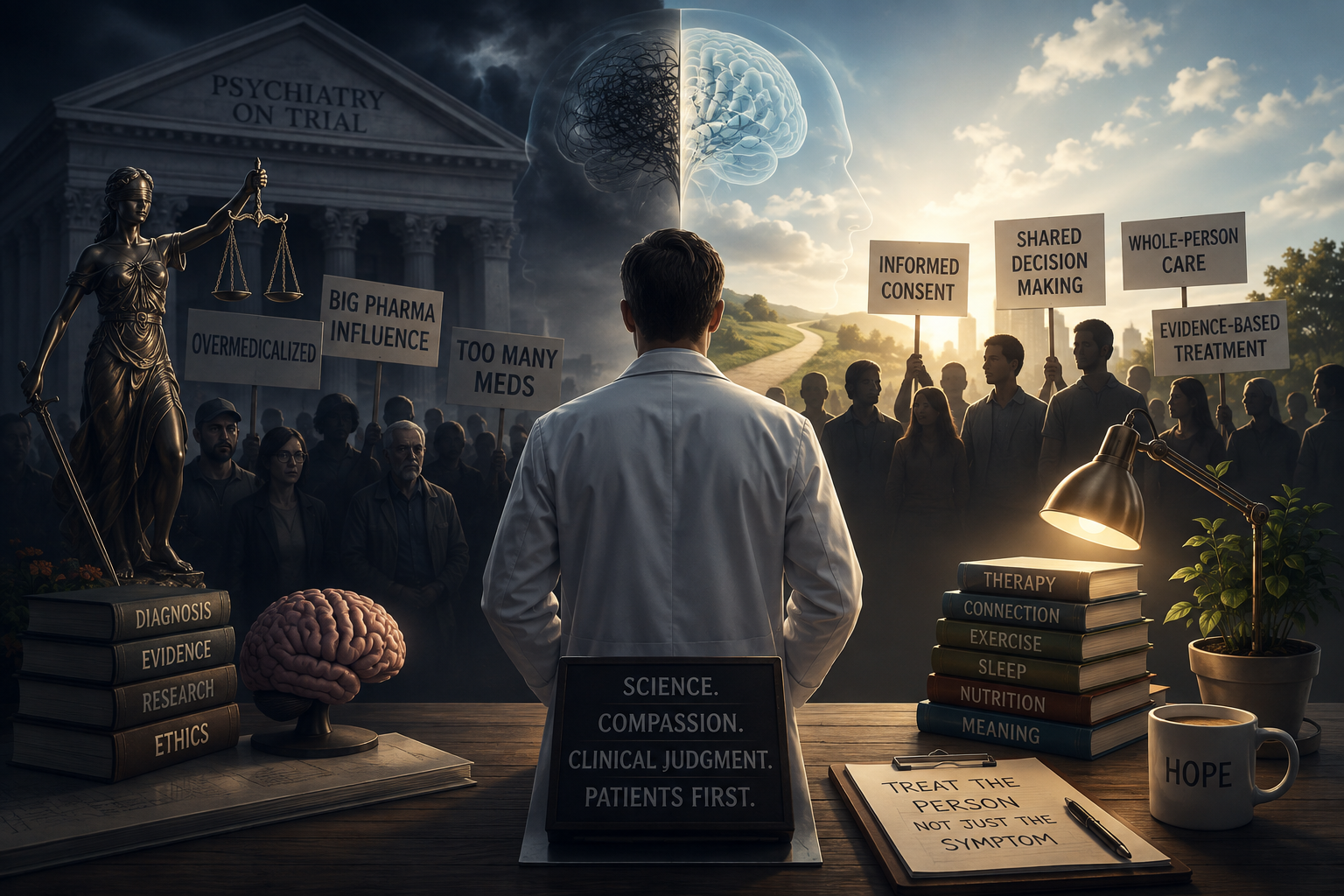
    On one side are the people who claim psychiatric disease isn’t real, that we’re medicating normal emotion, that diagnosis is social construction, that psychiatry exists to enrich pharmaceutical companies and serve as gatekeepers for a coercive system.

    This is the most extreme antipsychiatry position. And anyone who has actually worked with the seriously mentally ill knows how detached from reality it is.

    Anyone who has sat with a patient in the middle of a manic episode, watched schizophrenia consume a young person’s future, or cared for a loved one whose personality and functioning were permanently altered by illness knows that serious mental illness is not a metaphor. It is not a branding problem. It is not a failure of social acceptance.

    It is real.

    It destroys lives.

    It fractures families.

    It changes the trajectory of everyone around it.

    To deny that is not compassionate. It is cruel.

    But there is a subtler version of denial, one that doesn’t reject psychiatric illness outright, but explains nearly everything through the lens of trauma.

    I don’t mean trauma in the strict PTSD sense. Not the defined clinical syndrome with intrusive memories, avoidance, negative alterations in mood and cognition, and hyperarousal. I mean the broader cultural reflex to frame almost every form of suffering, dysregulation, or dysfunction as “trauma.”

    Trauma matters. Adverse experiences shape brain development, attachment, emotional regulation, interpersonal functioning, substance use, and psychiatric vulnerability. Trauma-informed care has improved medicine, especially by reminding clinicians not to mistake survival strategies for character flaws.

    But trauma does not explain everything.

    It does not explain every case of bipolar disorder. It does not explain every case of schizophrenia. It does not explain every recurrent psychotic episode, every manic state, every severe melancholic depression, or every disabling case of OCD.

    Sometimes the illness is the illness.

    Sometimes the problem is not that society failed to understand a person’s pain. Sometimes the problem is that a devastating psychiatric disease has emerged, and without treatment, it will keep dismantling that person’s life.

    But the opposite error is just as common, and at least as harmful.

    Some clinicians see mental illness in everything.

    They accept every DSM category as if it were a blood test result. They are not critical enough of psychiatry’s limitations. They recognize suffering, and because they want to help, they reach for diagnosis. They reach for medication. They reach for neuromodulation. They reach for a treatment plan that looks medical, billable, and actionable.

    But not every form of suffering is a psychiatric disease.

    Some suffering is grief.

    Some suffering is loneliness.

    Some suffering is moral injury.

    Some suffering is poverty.

    Some suffering is addiction, family chaos, social collapse, lack of purpose, bad relationships, unemployment, burnout, or the consequences of repeated poor decisions.

    Some suffering is just the pain of being human in a world that doesn’t give people much room to fall apart.

    That doesn’t make it fake. It doesn’t mean the person doesn’t deserve help.

    It means the help they need may not live inside a pill bottle.

    This is one of the hardest conversations in psychiatry.

    A patient is suffering. Their family is desperate. Everyone wants the problem named. Everyone wants the plan, the timeline, the medication, the diagnosis, the insurance code, the discharge plan, the promise that things will get better quickly.

    But sometimes the honest answer is:

    “I believe you are suffering. I believe you need help. But I am not convinced that what you have is best understood as a medication-responsive psychiatric disease.”

    That is not abandonment. That is clinical honesty.

    And it is much harder than simply prescribing something.

    The pressure to diagnose is everywhere.

    Families want answers. Hospitals need billable codes. Insurance companies require DSM or ICD diagnoses. Patients often arrive already convinced that if their suffering is severe enough, it must be a disorder. Clinicians are trained inside systems where diagnosis drives reimbursement, treatment authorization, length of stay, documentation, and discharge planning.

    The incentives quietly push us toward overdiagnosis.

    Not always because clinicians are careless. Often because that is simply how the system works.

    A person presents in crisis. They are admitted to an inpatient psychiatric unit. The system expects a psychiatric diagnosis. But not everything that gets someone admitted to inpatient psychiatry is caused by a primary psychiatric disease.

    Sometimes it is. Absolutely. Sometimes it is mania, psychosis, melancholic depression, catatonia, severe OCD, or a lethal depressive episode.

    Those cases need aggressive, evidence-based psychiatric treatment. Medication can be lifesaving. ECT can be lifesaving. Lithium, clozapine, antipsychotics, long-acting injectables, lifesaving. We should never minimize that. Untreated serious mental illness can destroy the patient’s life and the family’s along with it.

    But other times the picture is far more complicated. There may be interpersonal chaos, substance use, housing instability, personality structure, trauma history, family conflict, legal problems, financial collapse, social isolation, or a profound absence of coping skills. The person is suffering, but the suffering does not map cleanly onto a discrete psychiatric disease.

    These patients often respond poorly to medication, because medication was never the main answer.

    Then, when the medication doesn’t work, everyone assumes the psychiatrist chose the wrong one.

    Try another SSRI. Add an antipsychotic. Add a mood stabilizer. Try ketamine. Try TMS. Try something stronger.

    But sometimes the problem isn’t treatment resistance.

    Sometimes the problem is diagnostic overreach.

    This is where psychiatry must be honest with itself.

    We can harm people in two opposite directions.

    We can harm them by failing to diagnose and treat real mental illness.

    We can harm them by diagnosing and treating something as mental illness when it isn’t.

    The first error leaves people untreated and at the mercy of their disease.

    The second exposes people to unnecessary treatment, side effects, identity shifts, stigma, financial cost, and the disappointment that follows when a promised medical solution fails to deliver.

    And when people are harmed by treatments they didn’t need, they often become psychiatry’s loudest critics.

    Not because they were always antipsychiatry.

    Because psychiatry overpromised. Because someone gave them a diagnosis that didn’t fit. Because someone medicalized their suffering without understanding their life.

    Psychiatry does not need to choose between naïve biological reductionism and total diagnostic nihilism. We need a more disciplined middle.

    When there is a clear psychiatric illness, recognizable course, symptom pattern, family history, severity, treatment-responsive biology, we should treat it seriously and decisively. No apologies. No hesitation. No pretending that schizophrenia is just “difference,” or mania is “spiritual awakening,” or severe depression is “sadness,” or OCD is “perfectionism.”

    But when the presentation is questionable, when the course doesn’t fit, when the diagnosis is being stretched to justify intervention, when the suffering is real but not clearly disease-based, we should slow down.

    We should listen longer. Widen the frame. Ask whether medication is likely to help. Consider psychotherapy, structure, sleep, substance use treatment, social repair, family boundaries, vocational support, lifestyle change, and time.

    We should be willing to say:

    “This is real suffering. But I am not going to pretend that a psychiatric label explains all of it.”

    That isn’t minimizing. That’s precision.

    The future of psychiatry depends on our ability to hold both truths at the same time.

    Mental illness is real.

    And not everything painful is mental illness.

    Some people desperately need psychiatric treatment and will be devastated without it. Others need compassion, structure, therapy, accountability, community, and support, but not a diagnosis that follows them for life, or medications that may do more harm than good.

    The goal is not to diagnose less. The goal is to diagnose better.

    The goal is not to medicate everyone. The goal is to treat the right condition, in the right person, at the right time, for the right reason.

    That is the psychiatry I believe in.

    Not psychiatry as social control.

    Not psychiatry as a pill for every problem.

    Psychiatry as a serious medical discipline, one that recognizes disease reality, respects human suffering, and has the humility to know the difference.

  • When Culture Moves Faster Than Science: Psilocybin Is Already in Your Clinic

    When Culture Moves Faster Than Science: Psilocybin Is Already in Your Clinic

    Here is what happens when culture moves faster than science.

    Before psilocybin becomes an FDA-approved treatment, before every safety question is answered, before we know how to responsibly scale psychedelic-assisted therapy, millions of Americans are already using it.

    According to a newly published analysis of the 2024 National Survey on Drug Use and Health, approximately 2.8% of Americans age 12 and older reported using psilocybin in the past year, corresponding to roughly 8 million people nationally. The study analyzed survey data from 58,633 respondents, and 2024 was the first year NSDUH included psilocybin-specific questions. 

    This is important, not because every person using psilocybin is doing something dangerous. Not because psilocybin has no therapeutic potential. The emerging research signal in depression, treatment-resistant depression, and substance use disorders is real enough to deserve rigorous study. In fact, the FDA recently announced regulatory actions intended to accelerate development of psychedelic-related treatments, including psilocybin for treatment-resistant depression and major depressive disorder. 

    But the problem is this: public enthusiasm is not the same thing as clinical evidence.

    And right now, the public is not waiting for the randomized controlled trials to finish.

    The survey found that psilocybin use was more common among males, young adults ages 18 to 25, and college-educated individuals. It was also strongly associated with use of cannabis, LSD, ketamine, and MDMA. 

    Most importantly for psychiatrists, psilocybin use was not randomly distributed across the population. People with a past-year major depressive episode were more likely to report psilocybin use. So were individuals with alcohol use disorder. 

    Because this means the people most likely to be experimenting with psilocybin are not necessarily the healthy, psychologically stable adults often imagined in wellness culture. They may be the very patients already sitting in our offices: depressed, anxious, drinking heavily, using cannabis, struggling with treatment resistance, frustrated with conventional psychiatry, or searching for something that feels more meaningful than another medication adjustment.

    This is where psychiatry has to grow up.

    The easy response is dismissal. “It’s illegal.” “It’s recreational.” “It’s just another drug trend.” That response will fail because it ignores what patients are already doing.

    The equally dangerous response is romanticization. “It’s natural.” “It’s ancient.” “It expands consciousness.” “It heals trauma.” That response also fails because it replaces medical evidence with cultural mythology.

    The clinical response has to be more serious than both.

    Psilocybin used in a controlled clinical trial is not the same thing as psilocybin used at home, at a retreat, at a party, in combination with cannabis, alcohol, MDMA, ketamine, or while taking serotonergic medications. Clinical trials involve screening, standardized dosing, structured preparation, psychological support, monitoring, and follow-up. Naturalistic use often has none of those safeguards.

    A patient with depression using psilocybin outside a clinical setting may be doing so because they are desperate, not because they are reckless. But desperation does not eliminate risk. Psychedelic experiences can be psychologically destabilizing. They can worsen anxiety, trigger panic, create prolonged distress, or complicate underlying bipolar spectrum illness, psychosis vulnerability, trauma symptoms, or substance use disorders.

    This does not mean psychiatrists should lecture patients.

    It means we should ask better questions.

    Not: “Are you using drugs?”

    But:
    “Have you used psilocybin, mushrooms, ketamine, MDMA, LSD, or other psychedelic substances in the past year?”
    “What were you hoping it would help with?”
    “What happened during and after the experience?”
    “Did you use it alone or with others?”
    “Were alcohol, cannabis, or other substances involved?”
    “Did it change your mood, sleep, anxiety, impulsivity, suicidal thoughts, or sense of reality afterward?”
    “Are you planning to use it again?”

    That is not endorsement. That is clinical reality.

    Whether psilocybin eventually becomes an FDA-approved psychiatric treatment or not, psychiatrists are going to see more patients who have used it, are considering using it, or believe it has already treated their depression, trauma, addiction, or existential distress.

    We need to be ready for that conversation.

    The future of psychedelic medicine should not be driven by excessive enthusiasm, venture capital, wellness influencers, or reactionary fear. It should be driven by careful science, honest risk assessment, clinical humility, and respect for the fact that patients are already making decisions before the field has reached consensus.

    Culture has moved first.

    Science is catching up.

    Psychiatry needs to be in the room before the narrative is written without us.

    Psychiatry Unfiltered

  • Is Antidepressant Withdrawal Overhyped? What the Evidence Really Says

    Is Antidepressant Withdrawal Overhyped? What the Evidence Really Says

    In my clinical practice, I’ve often found myself scratching my head over the narrative surrounding antidepressant withdrawal.

    I’m not denying that withdrawal is real—it is. And for a small subset of patients, it can be quite distressing. But what I am saying is this: it’s not nearly as common, dramatic, or dangerous as some online circles and sensational stories would have you believe.

    I’ve seen countless patients abruptly stop antidepressants and experience no withdrawal symptoms. I’ve also aggressively tapered antidepressants in patients with bipolar disorder to prevent mood destabilization—again, with little to no evidence of withdrawal. This isn’t a one-off observation. It’s a consistent clinical pattern I’ve noted for years. So, I asked myself: What does the data actually say?

    The Evidence

    A 2024 meta-analysis published in JAMA Psychiatry examined 49 randomized controlled trials and finally gave us some clarity.

    The results?
    ✅ People discontinuing antidepressants reported on average just one more symptom than those who either continued medication or discontinued a placebo.
    ✅ The most commonly reported symptoms in the first two weeks were dizziness, nausea, vertigo, and nervousness—exactly what I’ve seen clinically.
    ✅ Critically, the average number of symptoms fell below the threshold for what’s considered a clinically significant discontinuation syndrome.
    ✅ There was no link between discontinuation and worsening depression, suggesting that if mood symptoms return, it’s likely a relapse—not withdrawal.

    Why This Matters

    There are vocal groups online—often with clear anti-psychiatry agendas—who focus exclusively on rare, severe cases of withdrawal and present them as the norm. The goal is simple: to scare people away from psychiatry and evidence-based treatment using emotional testimonials instead of clinical reality.

    Let’s be honest—those cases do exist, but they are not representative of what most patients experience.

    As clinicians, we should remain cautious and responsible. Yes, we should taper medications thoughtfully. Yes, we should prepare patients for the possibility of withdrawal symptoms. But we also shouldn’t scare them into avoiding treatment—or make them feel trapped on medications for life.

    Bottom Line

    Antidepressant withdrawal can happen. It can be uncomfortable. But it’s rarely severe and almost never dangerous. The fear around it has been overstated by those with an ax to grind. We owe it to our patients to treat based on evidence, not anecdotes.

  • Brexpiprazole + Sertraline: A New Hope for PTSD Treatment

    Brexpiprazole + Sertraline: A New Hope for PTSD Treatment

    We’ve all seen it: PTSD that won’t budge. Patients try sertraline or paroxetine—the so-called “gold standards”—and walk away with little more than side effects and a sense of failure.

    Enter a new contender: brexpiprazole + sertraline.

    A recent Phase 3 randomized controlled trial might finally offer something real for those stuck in the PTSD trenches.

    🚨 The Results

    In a study across 86 sites with over 550 adults, adding brexpiprazole (2–3 mg) to sertraline (150 mg) led to a 5.6-point greater reduction on the CAPS‑5 (the gold-standard PTSD measure) compared to sertraline + placebo. That’s not a marginal win—it’s a clinically significant shift, especially in a treatment-resistant population.

    Responder rates tell the story even clearer:

    • 68.5% of patients on the combo had ≥30% reduction in symptoms
    • Compared to 48.2% on sertraline alone
    • That’s a +20% absolute response rate boost

    And the improvements weren’t just short-lived. Benefits held through 12 weeks, even during a post-treatment observation period. No relapse, no rebound—just stability.

    🧩 More Than Symptom Checklists

    It wasn’t just about PTSD symptoms. This combo also:

    • Improved psychosocial functioning (B-IPF scores)
    • Reduced anxiety and depression (HADS)
    • Lowered global illness severity (CGI-S)
    • Helped with all symptom clusters, including reexperiencing, avoidance, and hyperarousal

    That’s rare. Most meds in psychiatry hit one or two domains and leave the rest hanging. This one made a dent where it counts: function, resilience, and real-world relief.

    ⚠️ What About Side Effects?

    Brexpiprazole is still an atypical antipsychotic, so there’s baggage. But the trial data suggest it’s relatively well-tolerated:

    • Fatigue: 6.8%
    • Weight gain: 5.9%
    • Somnolence: 5.4%
    • Discontinuation due to AEs? Just 3.9%, vs 10.2% in placebo.

    No new safety signals. No psychosis worsening. Not perfect, but not the metabolic disaster zone we see with other agents.

    🚀 What’s Next?

    The FDA is reviewing this combo

    For those of us treating chronic PTSD, this may be a real tool—not just a shiny new molecule with good marketing.

    Until then, it’s worth paying attention. Because when sertraline alone doesn’t cut it—and we know it often doesn’t—this combo could offer a lifeline.

  • 🧠 Blog Post: The Dark Mirror—How Screen Time Drains Our Mental Health

    🧠 Blog Post: The Dark Mirror—How Screen Time Drains Our Mental Health

    It’s no secret that screen time affects our mental health—but we still underestimate just how deeply it cuts.

    As a psychiatrist, I find myself glued to my phone far more than I’d like. I’m not scrolling TikTok—I’m answering emails, responding to messages, and compulsively checking patient updates. Yet, even in this “productive” digital use, I feel drained. The compulsion to keep checking leaves me feeling hollow and anxious.

    Now imagine that same digital pull in the hands of a developing mind.

    A recent study in JAMA examined over 4285 adolescents and found a clear link: teens with high levels of addictive digital media use were significantly more likely to report depression, anxiety, and suicidal thoughts.

    The connection isn’t surprising. Much of what’s consumed online isn’t educational or uplifting—it’s filtered perfection, highlight reels, and influencer fantasy. The more time spent scrolling, the easier it is to feel like you’re falling behind in life, socially or emotionally.

    It’s telling that Steve Jobs famously limited his own children’s access to screens, despite pioneering the very technology we now feel chained to.

    This isn’t about demonizing devices—it’s about reclaiming our attention and protecting mental space, especially for young people.

    We need digital hygiene just like we need physical hygiene. That means:

    • Setting screen-time boundaries
    • Promoting offline connection
    • Reframing how we compare ourselves to curated content

    Mental health isn’t just shaped in the therapy room—it’s shaped by the world we scroll through every day.

  • Understanding Psychiatry: Science vs. Skepticism

    Understanding Psychiatry: Science vs. Skepticism

    🧠 “Psychiatry is a scam.” “Big Pharma controls your brain.” “Mental illness isn’t real.”

    You’ve heard the takes. Now here’s the truth.

    In my new article for Psychiatric Times, I dive headfirst into the controversy:
    👉 Understanding Psychiatry: Navigating Skepticism and Science
    https://www.psychiatrictimes.com/view/understanding-psychiatry-navigating-skepticism-and-science

    I don’t dodge the hard questions—about overmedication, broken trust, and bad science—but I also push back against lazy anti-psychiatry takes that ignore the very real suffering of patients.

    If you care about the future of mental health care, this one’s worth your time.

  • Mirtazapine: A unique tool in the antidepressant toolbox

    Mirtazapine isn’t your typical SSRI—and that’s exactly why it can be useful in the right context.

    ✅ When to consider mirtazapine:

    • Depression with insomnia
    • Poor appetite or weight loss
    • Concern about sexual side effects
    • Patients struggling with GI intolerance to SSRIs

    ⚠️ When to avoid it:

    • Obesity or metabolic syndrome
    • Risk of daytime sedation
    • Orthostatic hypotension history

    Mechanistically, it’s a noradrenergic and specific serotonergic antidepressant (NaSSA). It works via alpha-2 autoreceptor blockade, enhancing 5-HT1A transmission while avoiding 5-HT2/3 activity—translating to fewer GI and sexual side effects.

    💡 Pro tip:
    Sedation is dose-dependent and paradoxical:
    Lower doses (7.5–15 mg) = more sedation
    Higher doses (30–45 mg) = less sedation

    In short, mirtazapine shines in cases where sleep, appetite, or tolerability limit other antidepressants—but use it strategically.

  • Reject dogma—embrace nuance in Psychiatry

    🔹 Psychoanalysis should not be treated as sacred doctrine. Freud was a clever and influential thinker, but not a prophet.


    🔹 Biological psychiatry is equally vulnerable to dogma. Not every symptom signals a disease, and not every distress warrants medication.


    🔹 That said, evidence-based pharmacology has its place—especially when medications show clear, replicable benefits in defined clinical conditions.

    The future of psychiatry lies in balanced thinking, not blind allegiance—to Freud, to biology, or to any single model of mind.

  • New JAMA Study Challenges Previous Concerns About Valproate and Paternal Risk

    New JAMA Study Challenges Previous Concerns About Valproate and Paternal Risk

    What we thought we knew may not hold up under scrutiny.

    A recent JAMA Psychiatry study titled “Disorders and Paternal Use of Valproate During Spermatogenesis” has delivered surprising news:

    There was no increased risk of neurodevelopmental disorders in children whose fathers were taking valproic acid around the time of conception.

    This finding directly challenges earlier observational data that suggested a possible link, leading to cautionary guidance against prescribing valproate to men of reproductive age. But now, with a large, well-conducted study showing no signal of harm, we’re left reconsidering that initial recommendation.

    As clinicians, we must remember:
    🔍 Association is not causation.
    🚧 Observational studies, while valuable, can mislead when confounding variables aren’t fully accounted for.
    📚 Evidence evolves—and so must our clinical guidance.

    This study not only impacts how we think about valproate use in men but also serves as a critical reminder about the limits of inference from non-randomized data.

    👉 For patients with bipolar disorder or epilepsy who benefit from valproate, this offers some reassurance. We may not need to withhold an effective treatment based on unconfirmed reproductive risks.

    📌 Bottom line: Always be skeptical. Always be curious. Always be willing to revise your practice when the data say it’s time.

    link to the study: https://jamanetwork.com/journals/jamanetworkopen/fullarticle/2834363

  • Negative symptoms of schizophrenia remain one of the toughest challenges in treatment

    These symptoms often include:
    🔹 Decreased motivation (avolition)
    🔹 Blunted or flat affect
    🔹 Reduced emotional range
    🔹 Paucity of speech (alogia)

    Unlike positive symptoms, negative symptoms respond poorly to antipsychotic medications—even clozapine, our most effective agent for treatment-resistant illness, offers limited relief.

    These deficits are often chronic, functionally disabling, and deeply impact quality of life.

    Tackling negative symptoms will be the next frontier in improving long-term outcomes in schizophrenia. We need innovative approaches, novel mechanisms, and more research focused on this under-addressed domain.