Tag: psychedelic medicine

  • When Culture Moves Faster Than Science: Psilocybin Is Already in Your Clinic

    When Culture Moves Faster Than Science: Psilocybin Is Already in Your Clinic

    Here is what happens when culture moves faster than science.

    Before psilocybin becomes an FDA-approved treatment, before every safety question is answered, before we know how to responsibly scale psychedelic-assisted therapy, millions of Americans are already using it.

    According to a newly published analysis of the 2024 National Survey on Drug Use and Health, approximately 2.8% of Americans age 12 and older reported using psilocybin in the past year, corresponding to roughly 8 million people nationally. The study analyzed survey data from 58,633 respondents, and 2024 was the first year NSDUH included psilocybin-specific questions. 

    This is important, not because every person using psilocybin is doing something dangerous. Not because psilocybin has no therapeutic potential. The emerging research signal in depression, treatment-resistant depression, and substance use disorders is real enough to deserve rigorous study. In fact, the FDA recently announced regulatory actions intended to accelerate development of psychedelic-related treatments, including psilocybin for treatment-resistant depression and major depressive disorder. 

    But the problem is this: public enthusiasm is not the same thing as clinical evidence.

    And right now, the public is not waiting for the randomized controlled trials to finish.

    The survey found that psilocybin use was more common among males, young adults ages 18 to 25, and college-educated individuals. It was also strongly associated with use of cannabis, LSD, ketamine, and MDMA. 

    Most importantly for psychiatrists, psilocybin use was not randomly distributed across the population. People with a past-year major depressive episode were more likely to report psilocybin use. So were individuals with alcohol use disorder. 

    Because this means the people most likely to be experimenting with psilocybin are not necessarily the healthy, psychologically stable adults often imagined in wellness culture. They may be the very patients already sitting in our offices: depressed, anxious, drinking heavily, using cannabis, struggling with treatment resistance, frustrated with conventional psychiatry, or searching for something that feels more meaningful than another medication adjustment.

    This is where psychiatry has to grow up.

    The easy response is dismissal. “It’s illegal.” “It’s recreational.” “It’s just another drug trend.” That response will fail because it ignores what patients are already doing.

    The equally dangerous response is romanticization. “It’s natural.” “It’s ancient.” “It expands consciousness.” “It heals trauma.” That response also fails because it replaces medical evidence with cultural mythology.

    The clinical response has to be more serious than both.

    Psilocybin used in a controlled clinical trial is not the same thing as psilocybin used at home, at a retreat, at a party, in combination with cannabis, alcohol, MDMA, ketamine, or while taking serotonergic medications. Clinical trials involve screening, standardized dosing, structured preparation, psychological support, monitoring, and follow-up. Naturalistic use often has none of those safeguards.

    A patient with depression using psilocybin outside a clinical setting may be doing so because they are desperate, not because they are reckless. But desperation does not eliminate risk. Psychedelic experiences can be psychologically destabilizing. They can worsen anxiety, trigger panic, create prolonged distress, or complicate underlying bipolar spectrum illness, psychosis vulnerability, trauma symptoms, or substance use disorders.

    This does not mean psychiatrists should lecture patients.

    It means we should ask better questions.

    Not: “Are you using drugs?”

    But:
    “Have you used psilocybin, mushrooms, ketamine, MDMA, LSD, or other psychedelic substances in the past year?”
    “What were you hoping it would help with?”
    “What happened during and after the experience?”
    “Did you use it alone or with others?”
    “Were alcohol, cannabis, or other substances involved?”
    “Did it change your mood, sleep, anxiety, impulsivity, suicidal thoughts, or sense of reality afterward?”
    “Are you planning to use it again?”

    That is not endorsement. That is clinical reality.

    Whether psilocybin eventually becomes an FDA-approved psychiatric treatment or not, psychiatrists are going to see more patients who have used it, are considering using it, or believe it has already treated their depression, trauma, addiction, or existential distress.

    We need to be ready for that conversation.

    The future of psychedelic medicine should not be driven by excessive enthusiasm, venture capital, wellness influencers, or reactionary fear. It should be driven by careful science, honest risk assessment, clinical humility, and respect for the fact that patients are already making decisions before the field has reached consensus.

    Culture has moved first.

    Science is catching up.

    Psychiatry needs to be in the room before the narrative is written without us.

    Psychiatry Unfiltered
  • Psychedelics Open the Door Then What?

    Psychedelics Open the Door Then What?

    Someone left a comment on my YouTube channel a while back: “He doesn’t know anything, he’s just a new graduate.” Fair enough. I should probably update my profile.

    For the record, I’ve been practicing psychiatry for five years post-residency now, and to put it mildly, I’ve seen a few things. I’ve sat across from patients fighting depression that won’t lift, PTSD that won’t quiet, bipolar illness that won’t stabilize, and the often-forgotten but equally devastating problem of simply trying to live a daily life. In the most complex cases, I struggle right alongside them. It takes a real toll on both sides of the therapeutic relationship. I didn’t enter medicine, and certainly not psychiatry, to helplessly watch people suffer.

    How I Got Hooked (No Pun Intended)

    I remember attending my first American Academy of Addiction Psychiatry annual meeting with my best friend, two excited second-year residents with a budding interest in addiction medicine. There were dozens of strong lectures that week, but one track lit me up: a series on psychedelic research, including data on mystical experience and the use of psilocybin in patients with terminal cancer.

    I was hooked. The work was compelling, novel, and almost completely absent from the standard residency curriculum. The literature has only grown since, building on a body of clinical research and on centuries of indigenous and traditional experience that came long before any of us showed up to a conference.

    Why the Psychedelic Conversation Matters Now

    People have told me my entire field is “pseudoscience at best.” I prefer to think of psychiatry as the most interpretive part of medicine, but everyone is entitled to an opinion.

    What most people across the spectrum do agree on is this: collective mental health is getting worse, and the current standard of care leaves a lot of people out in the cold. There is a large gap, and it is begging to be filled. Right now, renewed clinical and cultural interest in psychedelics is rushing in to fill it.

    Everything old is new again. Postwar America saw a similar wave in the 1960s, a counterculture pushing back against the status quo with these compounds in hand, and we blew it. We were reckless, the political backlash was severe, and the scientific window slammed shut for a generation. We have a chance now to do this differently: to do the actual science, to understand these medicines, and to deliver them safely. I have written extensively about that elsewhere, and I will continue to.

    This piece is about something else.

    What I’ve Actually Seen in the Room

    After five years of treating serious mental illness, treatment-resistant depression, and addiction, here is the unglamorous clinical truth I want anyone considering psychedelic therapy to hear:

    I have rarely seen lasting recovery come from medication alone.

    Not on SSRIs. Not on mood stabilizers. Not on stimulants. And, this is the part the hype train usually skips, not on psychedelics either.

    Medication can take the edge off. It can crack a window in a sealed room. But without a concerted effort to change how a person thinks, what they believe about themselves, and how they show up in their own life, relief is often partial and temporary. Old patterns reassert themselves with depressing reliability.

    Being well, actually well, not just less symptomatic, is a far more complex process than adding a molecule. Even when that molecule is a powerful psychedelic that can temporarily reroute the circuits that have run a patient’s life into the ground.

    The Onion and the Ego

    This is where ego dissolution comes in.

    Psychedelics, used well, can do something extraordinary. They can peel back the layers, the conditioning, the wounds, the social performance, the inherited beliefs – and offer a person something close to a blank canvas. The experience is often described as a multi-stage journey: a descent into the subconscious, a confrontation with personal shadow material, and an ascent toward integration. Anyone who has sat with patients in the days after a session knows that structure is not imaginary.

    But dissolving the ego is only half the work. Maybe less.

    There has to be a rebuilding. Otherwise, the process can end in chaos, disorientation, drift, or destabilization. For all the cultural and societal programming embedded in the ego, the ego also has a job. It organizes. It protects. It gives a person a sense of continuous self. You do not want it gone so much as loosened, examined, and put back together with more skill.

    A Spiritual Problem in a Secular Age

    Here is where I will say something that may cost me a few subscribers: for many patients, psychedelic experiences can feel like a return to something sacred, however they define it.

    Nietzsche famously wrote, “God is dead. God remains dead. And we have killed him.” That line is usually quoted as a takedown of religion. I read it more as a diagnosis. Religious authority is not what it used to be, fine, but the bigger problem is the void it left behind. Not a physical void. An existential one. And that is much harder to fill.

    A great deal of suffering in modern mental health is not only symptomatic. It is existential. It is about disconnection, meaning, identity, and the felt sense that nothing larger is holding the pieces together. This is where psychedelics, used carefully, may do something SSRIs cannot. The mystical experience, that sense of being part of something larger, more connected, less small, is precisely what many patients are starving for. It offers a temporary transcendence of the cages we live inside and a reminder that the ego’s account of who we are is not the whole story.

    The Limitation Nobody Wants to Talk About

    Here is the catch, and it is a big one.

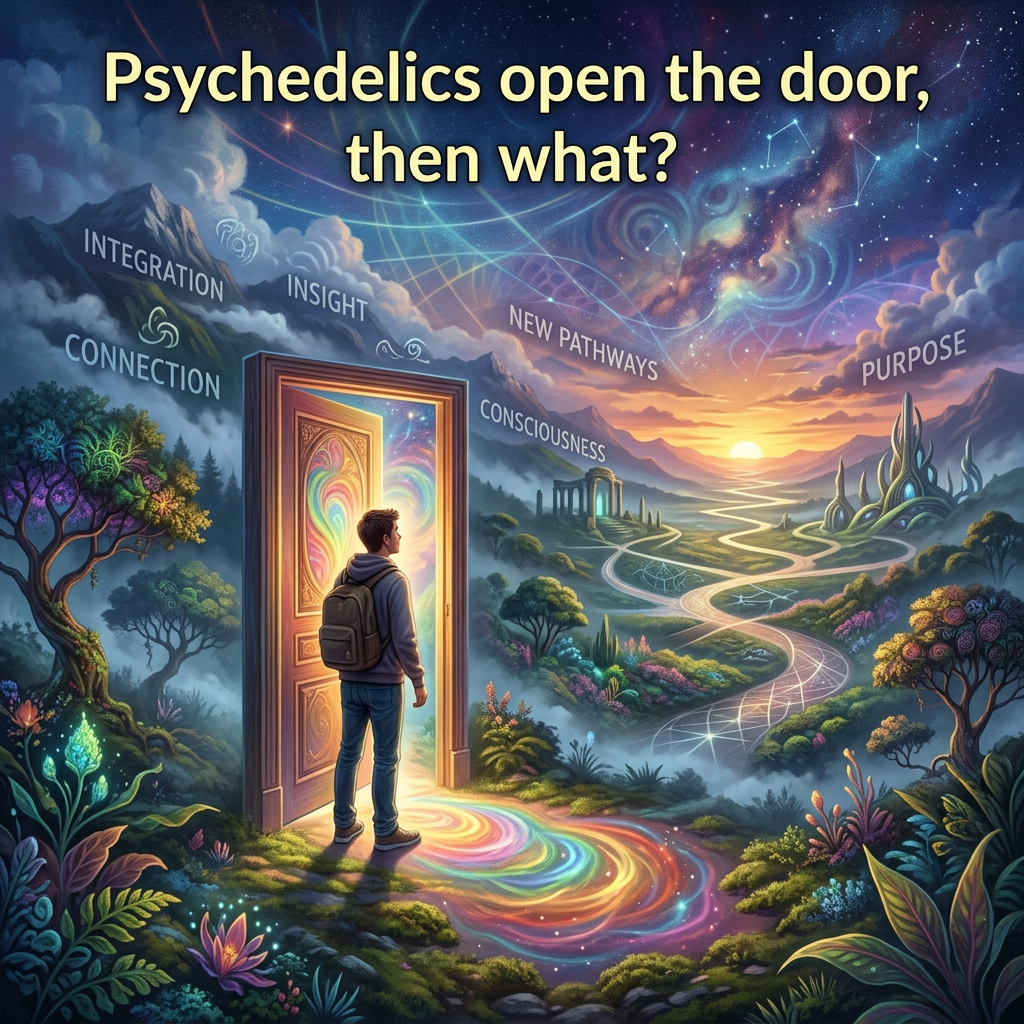
    Psychedelics can show us the possibility of what we could be and how the world could feel. They do not teach us how to embody that possibility once we come back down.

    It is like buying the book that is supposed to change your life, finishing it, and realizing it handed you the concept but not the protocol. The map, not the legs.

    In my view, this will be one of the central questions of the psychedelic revolution in both medicine and culture: when we strip away the layers that make us who we think we are, what do we replace them with?

    Will the medicine alone be enough? I do not think so. For people to genuinely transcend rigid thought patterns and live differently, something larger has to shift: a societal opening toward the slow work of integration, lived community, meaning-making, and the willingness to pursue some form of inner life without being constantly dragged back by money, politics, and a version of the American dream that has metabolized into burnout for much of the country.

    Without some broader change in how we live, think, and treat each other, psychedelic therapy risks becoming a high-end coping mechanism. People will dose, briefly touch something profound, and then return to the same conditions that drove the depression in the first place. So they will dose again. And again.

    What the Old-Timers Knew

    This is both a beacon of hope and a cautionary tale, and not from me. From the people who walked this path long before psychiatry got around to studying it. The medicines open the door. They do not walk you through it.

    The deepest insight – the one many patients eventually report after the sessions, the integration, and the work – is almost embarrassingly simple: the beauty of everyday life and ordinary connection was already there. The medicine just got the ego out of the way long enough to let them see it.

    The work, your work, my work, our work, is figuring out how to keep seeing it once the medicine wears off.

  • The psychedelic conversation in psychiatry is at an inflection point

    The psychedelic conversation in psychiatry is at an inflection point

    I believe these treatments deserve serious study. In fact, some of the most promising work in modern psychiatry is happening in this space. Psilocybin has FDA breakthrough therapy designation for treatment-resistant depression, MDMA-assisted therapy has shown meaningful promise in PTSD, and ibogaine is generating legitimate research interest in opioid use disorder and traumatic brain injury. 

    But promise is not proof.

    In my new Psychiatric Times article, I make the case that psychedelics deserve real science, not political shortcuts, podcast-driven enthusiasm, or regulatory acceleration built on weak evidence. The core issue is not whether we should study these compounds. We should. The issue is whether observational data, open-label studies, and viral claims are being asked to carry more weight than they should. 

    When a treatment has real risks, especially one like ibogaine with known cardiac concerns, the answer cannot be to lower the evidentiary bar. It has to be to raise the quality of the research. That means adequately powered randomized trials, careful safety monitoring, standardized outcomes, and enough humility to admit what we do not yet know. 

    Psychiatry does need better tools. Our patients need them badly. But if we want innovation that lasts, it has to be built on rigor, not hype.

    My latest piece in Psychiatric Times“Psychedelics Deserve Real Science”