There is a dangerous difference between criticizing bad psychiatric practice and stigmatizing psychiatric illness.
I have criticized aspects of psychiatry many times. I believe our field should be open to critique. We should question our prescribing habits. We should challenge lazy diagnosis. We should acknowledge when medications are used too quickly, continued too long, or substituted for the deeper work of psychotherapy, lifestyle change, social support, and careful clinical formulation.
Psychiatry should never be above criticism.
But criticism of psychiatric practice is not the same thing as denying the legitimacy of psychiatric illness.
And right now, that line is being blurred.
Serious Mental Illness Is Real
One thing you will never hear me say is that psychiatric disease is not real.
Schizophrenia is real.
Bipolar disorder is real.
Severe major depression is real.
Catatonia is real.
Psychotic depression is real.
Obsessive-compulsive disorder can be profoundly disabling.
Posttraumatic stress disorder can devastate a person’s life.
These are not character flaws. They are not weakness. They are not simply failures of lifestyle, discipline, resilience, spirituality, or mindset.
They are legitimate medical illnesses.
That does not mean every painful experience is a disease. It does not mean every person who is grieving, anxious, overwhelmed, lonely, or struggling needs a diagnosis or a medication. In fact, one of the most important tasks in psychiatry is knowing the difference.
Some people need medication.
Some people need psychotherapy.
Some people need sleep, exercise, nutrition, structure, social connection, housing, safety, meaning, accountability, or community.
Many people need several of these at the same time.
The goal is not to medicalize all suffering. The goal is to recognize real illness when it is present and treat it with the seriousness it deserves.
The Problem Is Not “Medication”
Psychiatric medications are often discussed as if they are inherently suspicious.
But medication is not the enemy.
Bad medicine is.
A medication can be life-changing when used for the right condition, in the right person, at the right time, for the right reason.
The same medication can be harmful when used carelessly, without a clear diagnosis, without follow-up, without discussion of risks and benefits, or without a plan for reassessment.
That is not unique to psychiatry.
Antibiotics can be lifesaving, but inappropriate antibiotic use causes harm. Opioids can be appropriate in some clinical contexts, but reckless prescribing devastated communities. Steroids can be powerful tools, but long-term unnecessary use can create major problems.
The issue is not whether medications are “good” or “bad.”
The issue is whether we are practicing medicine well.
Deprescribing Matters, But It Is Not a Mental Health Policy
Deprescribing is important.
Every psychiatrist I know has experience reducing, simplifying, or stopping medications when the risks outweigh the benefits or when the original indication no longer makes sense.
This is not a fringe idea. It is part of daily psychiatric practice.
We stop medications that are not helping.
We reduce unnecessary polypharmacy.
We simplify regimens when possible.
We monitor side effects.
We reassess diagnoses.
We talk with patients about what still makes sense.
Good psychiatry includes deprescribing.
But deprescribing alone will not solve the mental health crisis.
People cannot deprescribe their way out of a lack of psychiatric beds. They cannot deprescribe their way out of months-long waitlists. They cannot deprescribe their way out of poverty, homelessness, trauma, addiction, loneliness, or a collapsing continuum of care.
And they cannot deprescribe their way out of schizophrenia, mania, catatonia, psychotic depression, or severe melancholic depression.
When we frame the mental health crisis primarily as a problem of overprescribing, we oversimplify a system failure.
We ignore the shortage of psychiatrists. We ignore the lack of access to psychotherapy. We ignore inadequate visit times, fragmented care, insurance barriers, emergency departments boarding psychiatric patients for days, and the near disappearance of a true continuum of care.
Those are not solved by telling people to take fewer medications.
The Risk of Stigma Dressed Up as Reform
My concern is not that we are talking about prescribing quality. We should be talking about that.
My concern is that the rhetoric around psychiatric medications often sends a dangerous message to people who already feel ashamed.
Many patients with serious mental illness already struggle with the idea of needing medication.
They worry it means they are weak.
They worry it means they are broken.
They worry it means they are dependent.
They worry it means they are not trying hard enough.
They worry others will see them differently.
When public conversations frame psychiatric medications as the central villain, those patients hear something very different from “we need better prescribing.”
They hear:
You are dependent.
You are addicted.
You are taking the easy way out.
You should be able to fix this naturally.
You are the problem.
That is not empowerment.
That is stigma.
And for some patients, that stigma can be dangerous. It can lead people to stop medications abruptly, avoid treatment, disengage from care, relapse, or delay help until a crisis occurs.
Of course patients should be informed. Of course they should understand risks and benefits. Of course they should have a voice in treatment decisions.
But informed consent should not become fear-based messaging. And reform should not become another way of shaming people with serious psychiatric illness.
Better Medicine Means Holding Two Truths
The future of psychiatry depends on our ability to hold two truths at the same time.
First, psychiatric illness is real and can be devastating.
Second, psychiatry must be careful not to overdiagnose, overprescribe, or turn normal human suffering into lifelong pathology.
Both truths matter.
If we only emphasize the first, we risk medicalizing everything.
If we only emphasize the second, we risk abandoning people with serious illness.
Real psychiatric care lives in the tension between those truths.
It requires humility. It requires careful diagnosis. It requires honest conversations about uncertainty. It requires medication when appropriate, psychotherapy when appropriate, lifestyle intervention when appropriate, social support when appropriate, neuromodulation when appropriate, and deprescribing when appropriate.
It also requires us to say clearly that some people need medication, and that needing medication is not a moral failure.
The Goal Is Better Medicine
The goal is not to prescribe more.
The goal is not to prescribe less.
The goal is to prescribe better.
Better diagnosis.
Better informed consent.
Better follow-up.
Better access to psychotherapy.
Better use of lifestyle interventions.
Better systems of care.
Better deprescribing when medications are no longer needed.
Better protection for people whose medications are the reason they are alive, stable, working, parenting, studying, and functioning.
We do not fix psychiatry by pretending psychiatric medications are always the answer.
But we also do not fix psychiatry by pretending they are the enemy.
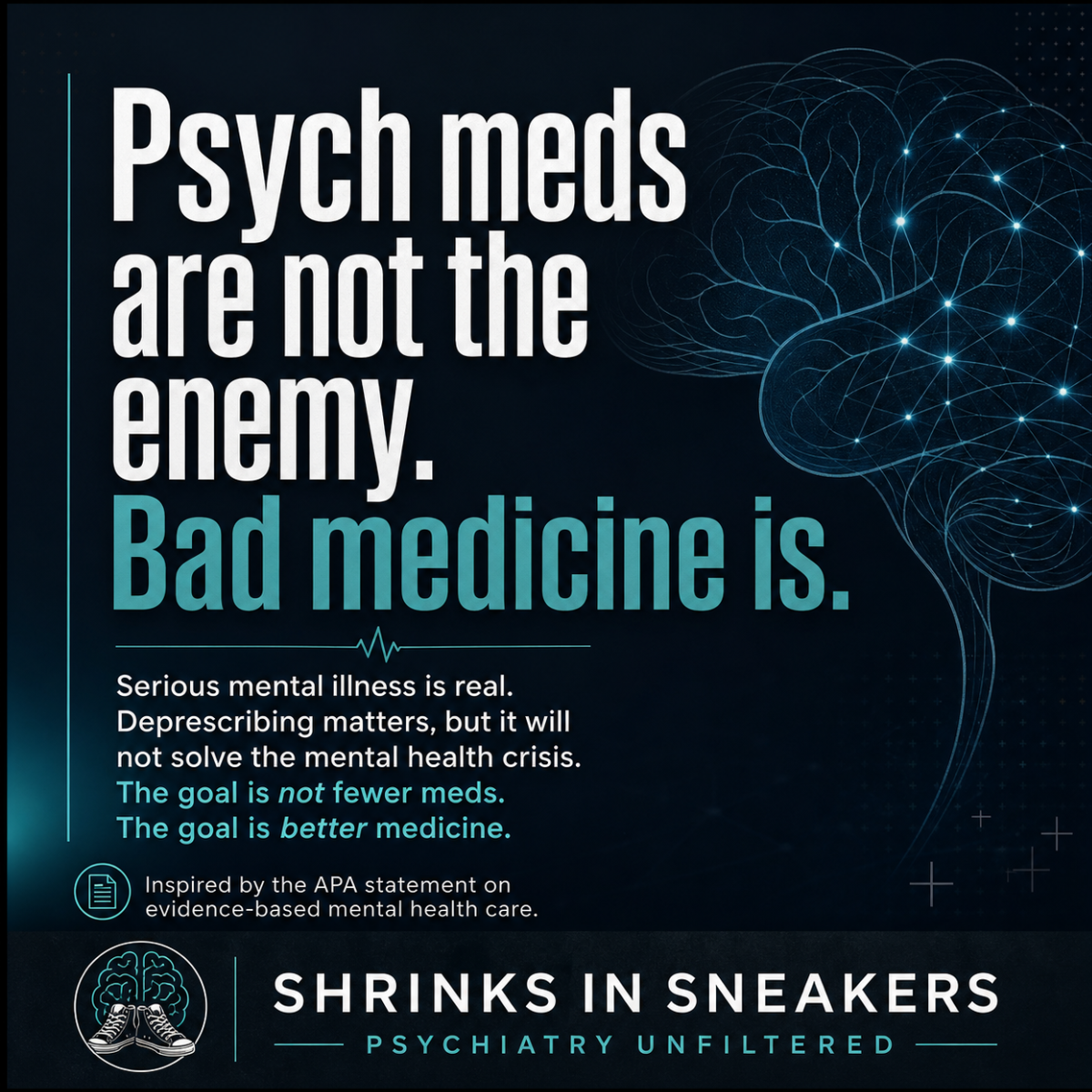
Psych meds are not the enemy.
Bad medicine is.