Tag: mental health equity

  • Psych Meds Are Not the Enemy. Bad Medicine Is

    Psych Meds Are Not the Enemy. Bad Medicine Is

    There is a dangerous difference between criticizing bad psychiatric practice and stigmatizing psychiatric illness.

    I have criticized aspects of psychiatry many times. I believe our field should be open to critique. We should question our prescribing habits. We should challenge lazy diagnosis. We should acknowledge when medications are used too quickly, continued too long, or substituted for the deeper work of psychotherapy, lifestyle change, social support, and careful clinical formulation.

    Psychiatry should never be above criticism.

    But criticism of psychiatric practice is not the same thing as denying the legitimacy of psychiatric illness.

    And right now, that line is being blurred.

    Serious Mental Illness Is Real

    One thing you will never hear me say is that psychiatric disease is not real.

    Schizophrenia is real.
    Bipolar disorder is real.
    Severe major depression is real.
    Catatonia is real.
    Psychotic depression is real.
    Obsessive-compulsive disorder can be profoundly disabling.
    Posttraumatic stress disorder can devastate a person’s life.

    These are not character flaws. They are not weakness. They are not simply failures of lifestyle, discipline, resilience, spirituality, or mindset.

    They are legitimate medical illnesses.

    That does not mean every painful experience is a disease. It does not mean every person who is grieving, anxious, overwhelmed, lonely, or struggling needs a diagnosis or a medication. In fact, one of the most important tasks in psychiatry is knowing the difference.

    Some people need medication.

    Some people need psychotherapy.

    Some people need sleep, exercise, nutrition, structure, social connection, housing, safety, meaning, accountability, or community.

    Many people need several of these at the same time.

    The goal is not to medicalize all suffering. The goal is to recognize real illness when it is present and treat it with the seriousness it deserves.

    The Problem Is Not “Medication”

    Psychiatric medications are often discussed as if they are inherently suspicious.

    But medication is not the enemy.

    Bad medicine is.

    A medication can be life-changing when used for the right condition, in the right person, at the right time, for the right reason.

    The same medication can be harmful when used carelessly, without a clear diagnosis, without follow-up, without discussion of risks and benefits, or without a plan for reassessment.

    That is not unique to psychiatry.

    Antibiotics can be lifesaving, but inappropriate antibiotic use causes harm. Opioids can be appropriate in some clinical contexts, but reckless prescribing devastated communities. Steroids can be powerful tools, but long-term unnecessary use can create major problems.

    The issue is not whether medications are “good” or “bad.”

    The issue is whether we are practicing medicine well.

    Deprescribing Matters, But It Is Not a Mental Health Policy

    Deprescribing is important.

    Every psychiatrist I know has experience reducing, simplifying, or stopping medications when the risks outweigh the benefits or when the original indication no longer makes sense.

    This is not a fringe idea. It is part of daily psychiatric practice.

    We stop medications that are not helping.
    We reduce unnecessary polypharmacy.
    We simplify regimens when possible.
    We monitor side effects.
    We reassess diagnoses.
    We talk with patients about what still makes sense.

    Good psychiatry includes deprescribing.

    But deprescribing alone will not solve the mental health crisis.

    People cannot deprescribe their way out of a lack of psychiatric beds. They cannot deprescribe their way out of months-long waitlists. They cannot deprescribe their way out of poverty, homelessness, trauma, addiction, loneliness, or a collapsing continuum of care.

    And they cannot deprescribe their way out of schizophrenia, mania, catatonia, psychotic depression, or severe melancholic depression.

    When we frame the mental health crisis primarily as a problem of overprescribing, we oversimplify a system failure.

    We ignore the shortage of psychiatrists. We ignore the lack of access to psychotherapy. We ignore inadequate visit times, fragmented care, insurance barriers, emergency departments boarding psychiatric patients for days, and the near disappearance of a true continuum of care.

    Those are not solved by telling people to take fewer medications.

    The Risk of Stigma Dressed Up as Reform

    My concern is not that we are talking about prescribing quality. We should be talking about that.

    My concern is that the rhetoric around psychiatric medications often sends a dangerous message to people who already feel ashamed.

    Many patients with serious mental illness already struggle with the idea of needing medication.

    They worry it means they are weak.
    They worry it means they are broken.
    They worry it means they are dependent.
    They worry it means they are not trying hard enough.
    They worry others will see them differently.

    When public conversations frame psychiatric medications as the central villain, those patients hear something very different from “we need better prescribing.”

    They hear:

    You are dependent.
    You are addicted.
    You are taking the easy way out.
    You should be able to fix this naturally.
    You are the problem.

    That is not empowerment.

    That is stigma.

    And for some patients, that stigma can be dangerous. It can lead people to stop medications abruptly, avoid treatment, disengage from care, relapse, or delay help until a crisis occurs.

    Of course patients should be informed. Of course they should understand risks and benefits. Of course they should have a voice in treatment decisions.

    But informed consent should not become fear-based messaging. And reform should not become another way of shaming people with serious psychiatric illness.

    Better Medicine Means Holding Two Truths

    The future of psychiatry depends on our ability to hold two truths at the same time.

    First, psychiatric illness is real and can be devastating.

    Second, psychiatry must be careful not to overdiagnose, overprescribe, or turn normal human suffering into lifelong pathology.

    Both truths matter.

    If we only emphasize the first, we risk medicalizing everything.

    If we only emphasize the second, we risk abandoning people with serious illness.

    Real psychiatric care lives in the tension between those truths.

    It requires humility. It requires careful diagnosis. It requires honest conversations about uncertainty. It requires medication when appropriate, psychotherapy when appropriate, lifestyle intervention when appropriate, social support when appropriate, neuromodulation when appropriate, and deprescribing when appropriate.

    It also requires us to say clearly that some people need medication, and that needing medication is not a moral failure.

    The Goal Is Better Medicine

    The goal is not to prescribe more.

    The goal is not to prescribe less.

    The goal is to prescribe better.

    Better diagnosis.
    Better informed consent.
    Better follow-up.
    Better access to psychotherapy.
    Better use of lifestyle interventions.
    Better systems of care.
    Better deprescribing when medications are no longer needed.
    Better protection for people whose medications are the reason they are alive, stable, working, parenting, studying, and functioning.

    We do not fix psychiatry by pretending psychiatric medications are always the answer.

    But we also do not fix psychiatry by pretending they are the enemy.

    Psych meds are not the enemy.

    Bad medicine is.

  • Mental Illness Is Real. Not Everything Painful Is

    Mental Illness Is Real. Not Everything Painful Is

    On the two opposite ways psychiatry harms patients, and the discipline to know the difference.

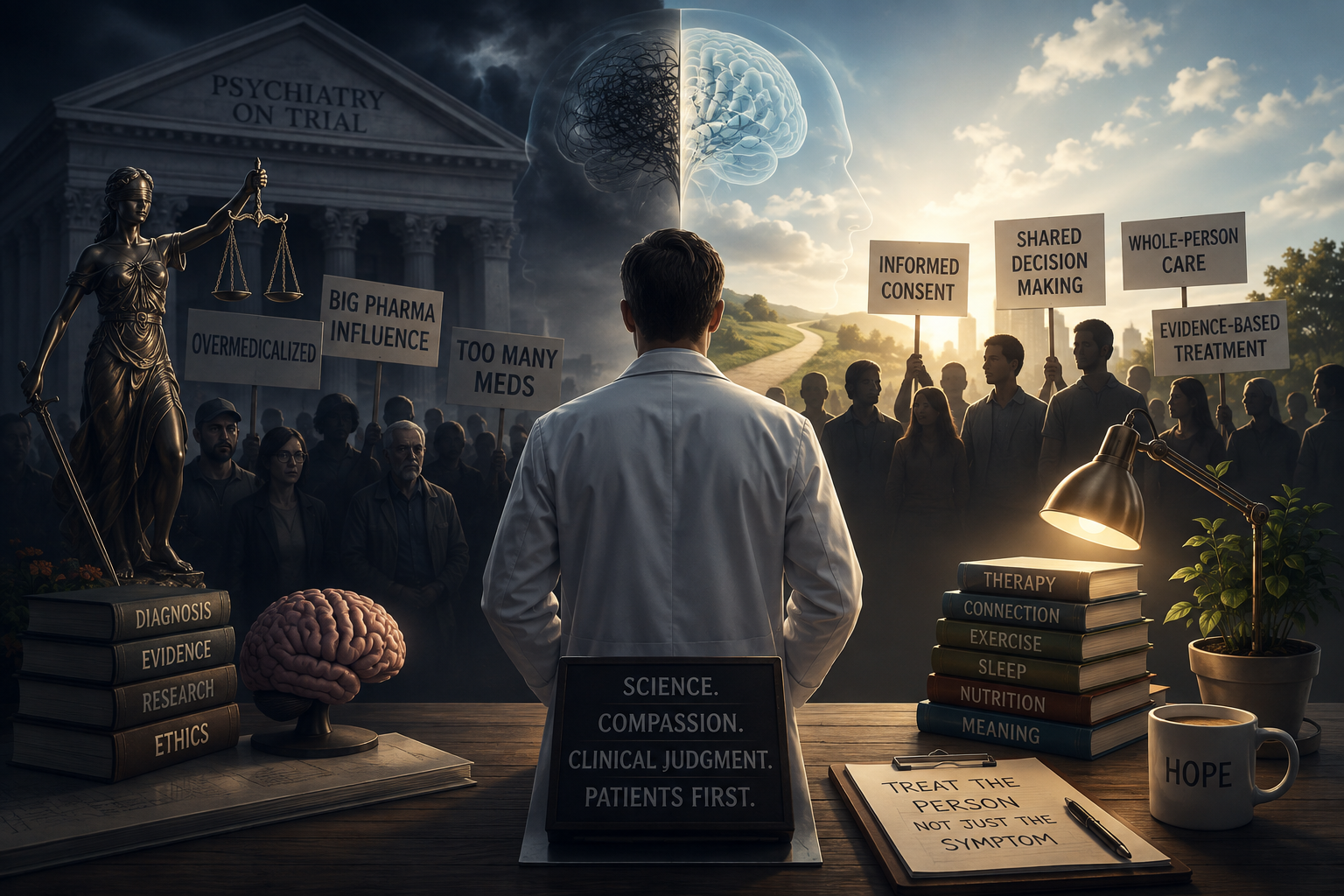
    There are two dangerous ways to talk about mental illness, and most public conversation manages to do both at once.

    The first is to deny that it exists.

    The second is to see it everywhere.

    Both are wrong. Both are harmful. Both leave patients worse off.

    On one side are the people who claim psychiatric disease isn’t real, that we’re medicating normal emotion, that diagnosis is social construction, that psychiatry exists to enrich pharmaceutical companies and serve as gatekeepers for a coercive system.

    This is the most extreme antipsychiatry position. And anyone who has actually worked with the seriously mentally ill knows how detached from reality it is.

    Anyone who has sat with a patient in the middle of a manic episode, watched schizophrenia consume a young person’s future, or cared for a loved one whose personality and functioning were permanently altered by illness knows that serious mental illness is not a metaphor. It is not a branding problem. It is not a failure of social acceptance.

    It is real.

    It destroys lives.

    It fractures families.

    It changes the trajectory of everyone around it.

    To deny that is not compassionate. It is cruel.

    But there is a subtler version of denial, one that doesn’t reject psychiatric illness outright, but explains nearly everything through the lens of trauma.

    I don’t mean trauma in the strict PTSD sense. Not the defined clinical syndrome with intrusive memories, avoidance, negative alterations in mood and cognition, and hyperarousal. I mean the broader cultural reflex to frame almost every form of suffering, dysregulation, or dysfunction as “trauma.”

    Trauma matters. Adverse experiences shape brain development, attachment, emotional regulation, interpersonal functioning, substance use, and psychiatric vulnerability. Trauma-informed care has improved medicine, especially by reminding clinicians not to mistake survival strategies for character flaws.

    But trauma does not explain everything.

    It does not explain every case of bipolar disorder. It does not explain every case of schizophrenia. It does not explain every recurrent psychotic episode, every manic state, every severe melancholic depression, or every disabling case of OCD.

    Sometimes the illness is the illness.

    Sometimes the problem is not that society failed to understand a person’s pain. Sometimes the problem is that a devastating psychiatric disease has emerged, and without treatment, it will keep dismantling that person’s life.

    But the opposite error is just as common, and at least as harmful.

    Some clinicians see mental illness in everything.

    They accept every DSM category as if it were a blood test result. They are not critical enough of psychiatry’s limitations. They recognize suffering, and because they want to help, they reach for diagnosis. They reach for medication. They reach for neuromodulation. They reach for a treatment plan that looks medical, billable, and actionable.

    But not every form of suffering is a psychiatric disease.

    Some suffering is grief.

    Some suffering is loneliness.

    Some suffering is moral injury.

    Some suffering is poverty.

    Some suffering is addiction, family chaos, social collapse, lack of purpose, bad relationships, unemployment, burnout, or the consequences of repeated poor decisions.

    Some suffering is just the pain of being human in a world that doesn’t give people much room to fall apart.

    That doesn’t make it fake. It doesn’t mean the person doesn’t deserve help.

    It means the help they need may not live inside a pill bottle.

    This is one of the hardest conversations in psychiatry.

    A patient is suffering. Their family is desperate. Everyone wants the problem named. Everyone wants the plan, the timeline, the medication, the diagnosis, the insurance code, the discharge plan, the promise that things will get better quickly.

    But sometimes the honest answer is:

    “I believe you are suffering. I believe you need help. But I am not convinced that what you have is best understood as a medication-responsive psychiatric disease.”

    That is not abandonment. That is clinical honesty.

    And it is much harder than simply prescribing something.

    The pressure to diagnose is everywhere.

    Families want answers. Hospitals need billable codes. Insurance companies require DSM or ICD diagnoses. Patients often arrive already convinced that if their suffering is severe enough, it must be a disorder. Clinicians are trained inside systems where diagnosis drives reimbursement, treatment authorization, length of stay, documentation, and discharge planning.

    The incentives quietly push us toward overdiagnosis.

    Not always because clinicians are careless. Often because that is simply how the system works.

    A person presents in crisis. They are admitted to an inpatient psychiatric unit. The system expects a psychiatric diagnosis. But not everything that gets someone admitted to inpatient psychiatry is caused by a primary psychiatric disease.

    Sometimes it is. Absolutely. Sometimes it is mania, psychosis, melancholic depression, catatonia, severe OCD, or a lethal depressive episode.

    Those cases need aggressive, evidence-based psychiatric treatment. Medication can be lifesaving. ECT can be lifesaving. Lithium, clozapine, antipsychotics, long-acting injectables, lifesaving. We should never minimize that. Untreated serious mental illness can destroy the patient’s life and the family’s along with it.

    But other times the picture is far more complicated. There may be interpersonal chaos, substance use, housing instability, personality structure, trauma history, family conflict, legal problems, financial collapse, social isolation, or a profound absence of coping skills. The person is suffering, but the suffering does not map cleanly onto a discrete psychiatric disease.

    These patients often respond poorly to medication, because medication was never the main answer.

    Then, when the medication doesn’t work, everyone assumes the psychiatrist chose the wrong one.

    Try another SSRI. Add an antipsychotic. Add a mood stabilizer. Try ketamine. Try TMS. Try something stronger.

    But sometimes the problem isn’t treatment resistance.

    Sometimes the problem is diagnostic overreach.

    This is where psychiatry must be honest with itself.

    We can harm people in two opposite directions.

    We can harm them by failing to diagnose and treat real mental illness.

    We can harm them by diagnosing and treating something as mental illness when it isn’t.

    The first error leaves people untreated and at the mercy of their disease.

    The second exposes people to unnecessary treatment, side effects, identity shifts, stigma, financial cost, and the disappointment that follows when a promised medical solution fails to deliver.

    And when people are harmed by treatments they didn’t need, they often become psychiatry’s loudest critics.

    Not because they were always antipsychiatry.

    Because psychiatry overpromised. Because someone gave them a diagnosis that didn’t fit. Because someone medicalized their suffering without understanding their life.

    Psychiatry does not need to choose between naïve biological reductionism and total diagnostic nihilism. We need a more disciplined middle.

    When there is a clear psychiatric illness, recognizable course, symptom pattern, family history, severity, treatment-responsive biology, we should treat it seriously and decisively. No apologies. No hesitation. No pretending that schizophrenia is just “difference,” or mania is “spiritual awakening,” or severe depression is “sadness,” or OCD is “perfectionism.”

    But when the presentation is questionable, when the course doesn’t fit, when the diagnosis is being stretched to justify intervention, when the suffering is real but not clearly disease-based, we should slow down.

    We should listen longer. Widen the frame. Ask whether medication is likely to help. Consider psychotherapy, structure, sleep, substance use treatment, social repair, family boundaries, vocational support, lifestyle change, and time.

    We should be willing to say:

    “This is real suffering. But I am not going to pretend that a psychiatric label explains all of it.”

    That isn’t minimizing. That’s precision.

    The future of psychiatry depends on our ability to hold both truths at the same time.

    Mental illness is real.

    And not everything painful is mental illness.

    Some people desperately need psychiatric treatment and will be devastated without it. Others need compassion, structure, therapy, accountability, community, and support, but not a diagnosis that follows them for life, or medications that may do more harm than good.

    The goal is not to diagnose less. The goal is to diagnose better.

    The goal is not to medicate everyone. The goal is to treat the right condition, in the right person, at the right time, for the right reason.

    That is the psychiatry I believe in.

    Not psychiatry as social control.

    Not psychiatry as a pill for every problem.

    Psychiatry as a serious medical discipline, one that recognizes disease reality, respects human suffering, and has the humility to know the difference.

  • We say we care about mental health in America

    We say we care about mental health in America

    We say we care about mental health in America.
    But the data—and my front-line experience—say otherwise.

    We are overmedicating, underfunding, and pathologizing poverty, trauma, and stress.
    Instead of addressing why people are sick, we throw pills at symptoms.

    🧠 In my latest article for Psychiatric Times, I make the case that we’ve built a system that profits off disease—not health.
    We’re not solving the problem. We’re institutionalizing it.

    If we want to make America healthy again, we need to stop doing the wrong things.

    👉 Read the full piece here: https://www.psychiatrictimes.com/view/if-we-want-to-make-america-healthy-again-we-are-doing-the-wrong-thing

  • 🧠 Blog Post: The Dark Mirror—How Screen Time Drains Our Mental Health

    🧠 Blog Post: The Dark Mirror—How Screen Time Drains Our Mental Health

    It’s no secret that screen time affects our mental health—but we still underestimate just how deeply it cuts.

    As a psychiatrist, I find myself glued to my phone far more than I’d like. I’m not scrolling TikTok—I’m answering emails, responding to messages, and compulsively checking patient updates. Yet, even in this “productive” digital use, I feel drained. The compulsion to keep checking leaves me feeling hollow and anxious.

    Now imagine that same digital pull in the hands of a developing mind.

    A recent study in JAMA examined over 4285 adolescents and found a clear link: teens with high levels of addictive digital media use were significantly more likely to report depression, anxiety, and suicidal thoughts.

    The connection isn’t surprising. Much of what’s consumed online isn’t educational or uplifting—it’s filtered perfection, highlight reels, and influencer fantasy. The more time spent scrolling, the easier it is to feel like you’re falling behind in life, socially or emotionally.

    It’s telling that Steve Jobs famously limited his own children’s access to screens, despite pioneering the very technology we now feel chained to.

    This isn’t about demonizing devices—it’s about reclaiming our attention and protecting mental space, especially for young people.

    We need digital hygiene just like we need physical hygiene. That means:

    • Setting screen-time boundaries
    • Promoting offline connection
    • Reframing how we compare ourselves to curated content

    Mental health isn’t just shaped in the therapy room—it’s shaped by the world we scroll through every day.

  • Understanding Psychiatry: Science vs. Skepticism

    Understanding Psychiatry: Science vs. Skepticism

    🧠 “Psychiatry is a scam.” “Big Pharma controls your brain.” “Mental illness isn’t real.”

    You’ve heard the takes. Now here’s the truth.

    In my new article for Psychiatric Times, I dive headfirst into the controversy:
    👉 Understanding Psychiatry: Navigating Skepticism and Science
    https://www.psychiatrictimes.com/view/understanding-psychiatry-navigating-skepticism-and-science

    I don’t dodge the hard questions—about overmedication, broken trust, and bad science—but I also push back against lazy anti-psychiatry takes that ignore the very real suffering of patients.

    If you care about the future of mental health care, this one’s worth your time.

  • Reject dogma—embrace nuance in Psychiatry

    🔹 Psychoanalysis should not be treated as sacred doctrine. Freud was a clever and influential thinker, but not a prophet.


    🔹 Biological psychiatry is equally vulnerable to dogma. Not every symptom signals a disease, and not every distress warrants medication.


    🔹 That said, evidence-based pharmacology has its place—especially when medications show clear, replicable benefits in defined clinical conditions.

    The future of psychiatry lies in balanced thinking, not blind allegiance—to Freud, to biology, or to any single model of mind.

  • 📉 Overdose Deaths in the U.S. Dropped Nearly 27% in 2024 – A Sign of Hope 🇺🇸

    📉 Overdose Deaths in the U.S. Dropped Nearly 27% in 2024 – A Sign of Hope 🇺🇸

    📉 Overdose Deaths in the U.S. Dropped Nearly 27% in 2024 – A Sign of Hope 🇺🇸

    According to newly released CDC data, the U.S. experienced a nearly 27% decline in overdose deaths last year — the first major drop in over five years. While the crisis is far from over, this marks a critical turning point and a reason for cautious optimism.

    Key contributors to this progress include:

    ✅ Expansion of harm reduction strategies

    ✅ Increased access to naloxone and medications for opioid use disorder

    ✅ Shifts in drug supply dynamics and targeted public health interventions

    As someone on the front lines caring for patients every day, I’ve witnessed firsthand the devastating toll of opioid addiction. I’ve lost patients to this crisis — and I’ve also seen close friends and family fight their way back from the brink. Their recovery wouldn’t have been possible without access to critical resources, especially life-saving medications and sustained support.

    This progress didn’t happen by chance — it’s the result of continued investment in prevention, treatment, and recovery. We cannot afford to lose momentum now. If anything, this is the moment to double down.

    Let’s keep the pressure on. Reach out to your representatives. Push for increased funding. Our collective commitment has brought us this far — now let’s go even further. Lives depend on it.

    Let’s build on this progress with compassion, science, and unwavering commitment.

  • Major Federal Healthcare Cuts: What Physicians Need to Know and How We Can Respond

    Major Federal Healthcare Cuts: What Physicians Need to Know and How We Can Respond

    A devastating blow to public health: More than $12 billion in federal grants—funding that supported infectious disease tracking, mental health services, addiction treatment, and other critical programs—has been canceled as part of recent federal budget cuts.

    These cuts threaten early detection of outbreaksaccess to psychiatric care, and lifesaving addiction treatment programs—all areas where we, as physicians, see the impact daily.

    Key Areas Affected:

    🚨 Infectious Disease Surveillance – Reduced ability to track emerging threats like COVID-19, flu, and antibiotic-resistant infections.
    🧠 Mental Health Services – Fewer resources for crisis response teams, community mental health centers, and psychiatric services.
    💉 Addiction Treatment – Less funding for MAT (medication-assisted treatment) and harm reduction programs at a time when overdose rates remain high.
    🏥 Public Health Preparedness – Cuts to pandemic readiness and emergency response training for healthcare workers.

    What Can We Do?

    🔹 Advocate – Contact legislators, professional organizations (APA, AMA, ACP), and demand restoration of funding.
    🔹 Educate – Inform patients and communities about how these cuts impact their care.
    🔹 Mobilize – Work with hospital leadership and local organizations to find alternative funding sources.
    🔹 Collaborate – Strengthen interprofessional partnerships to sustain services despite budget constraints.

    We’ve seen what happens when public health is underfunded—it costs more lives and more money in the long run. We can’t afford to be silent.

  • Can Low-Dose LSD Treat ADHD? A New Study Weighs In

    Can Low-Dose LSD Treat ADHD? A New Study Weighs In

    ADHD (Attention-Deficit/Hyperactivity Disorder) affects millions of adults worldwide, with stimulants like methylphenidate and amphetamine being the most effective treatments. But could psychedelics like LSD offer an alternative? A new randomized clinical trial aimed to find out.

    👉 Study Overview:

    • Design: Multicenter, double-blind, placebo-controlled trial (N = 53)
    • Participants: Mean age 37 years, 42% female
    • Intervention: Low-dose LSD (20 μg) or placebo twice weekly for 6 weeks (12 doses total)
    • Primary Outcome: Change in ADHD symptoms using the Adult ADHD Investigator Symptom Rating Scale (AISRS)

    💡 Key Findings:

    • Both groups showed significant improvement in ADHD symptoms:
      • LSD group: −7.1 points (95% CI, −10.1 to −4.0)
      • Placebo group: −8.9 points (95% CI, −12.0 to −5.8)
    • ✅ LSD was safe and well tolerated
    • ❌ No significant difference between LSD and placebo in symptom reduction

    🧠 What This Means:
    While low-dose LSD was safe, it didn’t outperform placebo in treating ADHD symptoms. This challenges anecdotal claims about psychedelics for ADHD and reinforces the need for rigorous placebo-controlled trials in psychedelic research.

    📈 Future research may explore higher doses or alternative mechanisms—but for now, stimulants remain the gold standard for ADHD treatment.

    🔗 https://jamanetwork.com/journals/jamapsychiatry/fullarticle/2831639

  • 🚨 Health Care is Under Attack

    🚨 Health Care is Under Attack

    Our patients are under attack. Our oath to do no harm is under attack. Health care is under attack.

    Last week, the U.S. House of Representatives passed a budget resolution that could slash $880 billion from Medicaid—a devastating blow that would strip 15.9 million people of health coverage. That’s 1 in 5 of your friends, neighbors, and patients.

    📉 Who will suffer most?
    🔹 Children
    🔹 The elderly
    🔹 People with disabilities
    🔹 Those living in poverty

    These are the people we serve every day

    We cannot stand by as essential care is ripped away from the most vulnerable. This is not a red or blue issue —this is a people issue.

    🩺 If you’re a healthcare professional, patient, or advocate, now is the time to speak up. Join us in the fight to protect Medicaid and ensure no one is left behind.